The Briney Waves

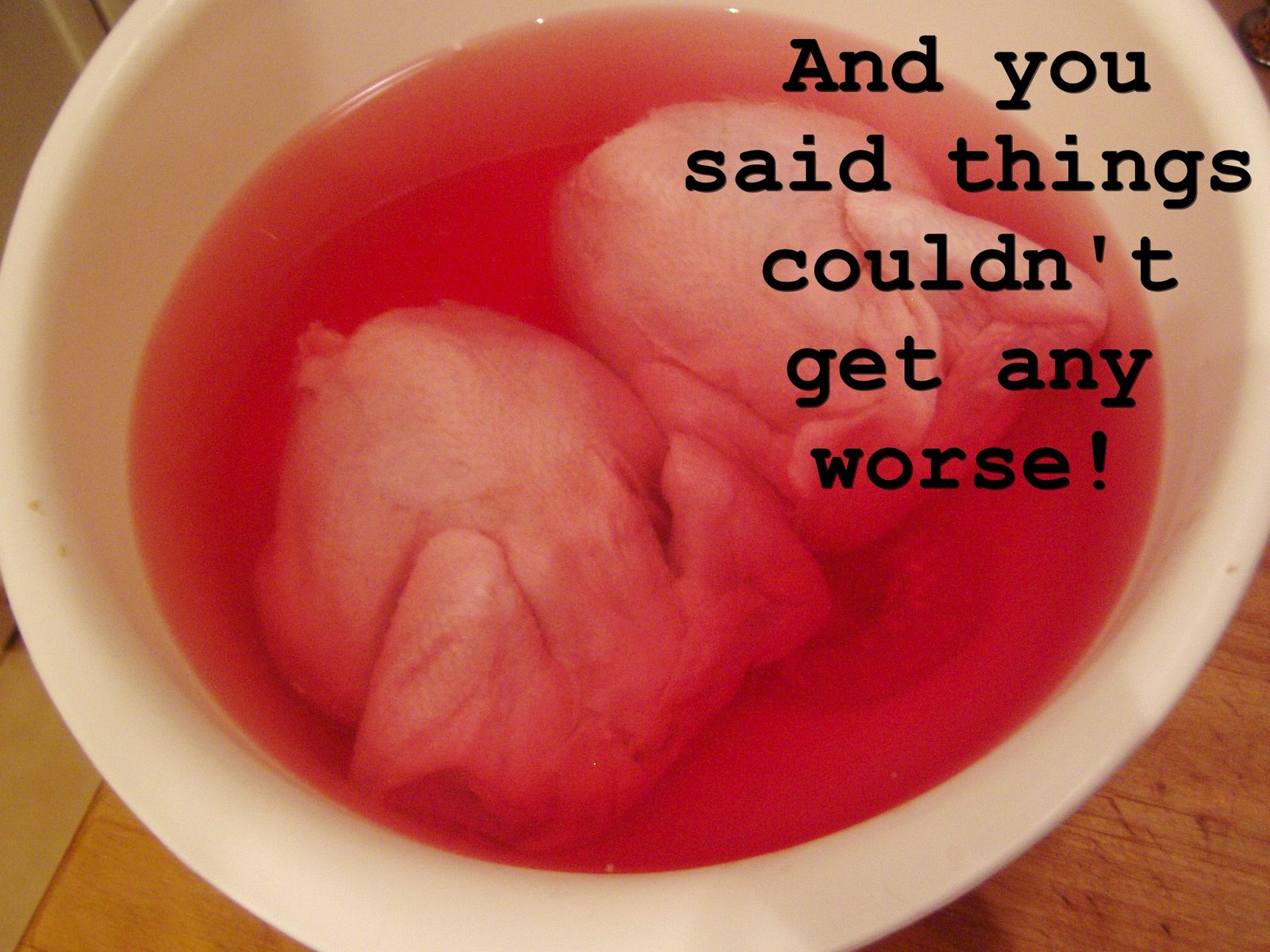
Just how long can you brine Cornish game hens before they shrivel up like prunes? On Monday I set out to cook two of them for our supper and started brining them, as the recipe I was attempting suggested.

Then Fred pipes up: “Can we eat now?”

“No problem,” I think. “We’ll have them tomorrow.”

“Tomorrow” we went back to Ikea for more furniture and ate pizza at a place where we had a coupon.

So our hens still sit in the refrigerator in their salt water bath, 48 hours later.

Results later today!

Oh Lard II

I am too tired from Easter “vacation” to write much. After working all day Friday around the house, trying to get our lives in something resembling order, Fred and I went to Elberton, Georgia on Saturday, where he preached on Sunday. I am pooped.

But feeling energetic on Friday morning, I used the lard to make biscuits. Results were not quite as satisfactory as with the soup. The biscuits were tender but too salty. I used Mrs. Dull’s recipe, which calls for “shortening.” Below is a modified version that should work better next time:

Sift together:
2 c. flour
1/2 tsp. baking soda
1/2 tsp. salt
4 tsp. baking powder

Cut in:
4 tbsp. lard

Stir in until just mixed:
1 cup buttermilk

Knead on well-floured surface until just mixed and smooth. Roll or spread out to 1/2″ thick. Cut with biscuit cutter or glass into size you like. Bake at 450 for 10 minutes or until brown.

Oh Lard!

I made the most spectacular soup I have ever had last night. It approaches Paul’s famous sandwich, The Hef.

The key ingredient was the LARD, mentioned in the Lardy Yellow Yard Sale post, rendered from a hog raised by a friend’s son-in-law. If you are able to find home-(killed? rendered? made?) lard you can easily replicate this at home. If not . . . too bad. I’m not sharing.

In large soup pot saute in 1 tbsp. lard and 2 tbsp. butter:
1 chopped onion

Add and saute for about 5 minutes:
2 thick slices Prague (or any not-too-salty) ham, cut in 1″ pieces
2-3 carrots, sliced

Add and saute for a few seconds:
2 large cloves minced garlic

Add salt and a generous amount of pepper.

Add 1 quart chicken stock. Cover and bring to boil. Add 1/2 head of coarsely chopped cabbage (1″ pieces or so). Reduce heat and cook until cabbage is just soft, about 10 – 15 minutes.

Tasty Trout

Sunday at the Farmer’s Market we saw a local chef buying trout. So being clever we got some too.

I am discovering that I don’t like fish pan-seared in oil, after a recent trout incident I did not bother to report because the fish was not very good. Instead I turned to the Great Broiler (Fred). Though he doesn’t really cook, his innate love of meat and his Southern upbringing seem give him a sixth sense about how to broil and fry things.

We salted and peppered the filets and marinated them for about 15 minutes in two gigantic cloves of garlic (minced), the juice of two lemons, and about a teaspoon of dill. We broiled on high for 2 minutes on the skin side and 3 on the side with skin. They were fabulous. Thank God for that chef.

Next time, though, I may just leave the skin side up the whole time to make it even crispier and tastier.

Lardy Yellow Yard Sale

According to one news report, the pollen count reached 5,937 particles per cubic meter of air yesterday–apparently the second-highest on record. (Apparently 120 is an “extremely high” count.) Even I have begun to feel it.

So has my dad’s 1979 Chevy Big 10 Bonanza, which I am now driving after my stuff was evicted from my mother’s office in Tennessee a couple of weeks ago. Its color has migrated from dark green to a kind of baby-puke yellow (Fred’s description)–a baby-puke yellow that now blankets nearly everything in sight.

The only good thing about all this is that no rain is forecast for tomorrow’s massive yard sale of the evicted stuff.

As for the lard–a friend’s son-in-law comes from a family that still butchers their own hogs. (See my comments to Paul in yesterday’s post.) We will be making biscuits soon and will be reporting results!

Sniffle. Sniffle.

And to top it all off: Louise and Cleo are scheduled for THEIR vet trip today. Catalina is the pee culprit, with a bladder infection (we think). I get to pill a cat every day for the next two weeks.

Sniffle.

We’re Back . . . .

. . . but Satan is down, its electronic innards seized up during one of its many evil fits–no doubt it passed out just from the sheer joy of making my online life as miserable as possible.

But it WILL submit, after I join forces with the Dell technician who sounds like Gandhi on speed to defeat it.

How have I managed to post this post, you ask? Well, it certainly wasn’t at work! And that’s all I have to say.

In the meantime, one of the four cats has blood in her urine–which one, we have no idea, as they don’t do us the courtesy of peeing in front of us. So while I’m on the phone with Dell, Fred will be trying to convince the cats to get into the carriers. He thinks he just needs to put some food in the back and they’ll walk right in “out of curiosity.” Sweet, isn’t it?

"Italian Grits" Revisited

Okay, so I seem to be a tiny bit . . . wrong . . . about polenta being a form of Italian grits.

I blame my grandparents. They used ground-up cornmeal for the dish they called grits, but apparently grits are made from ground hominy. Polenta is made from cornmeal mush, and it’s stirred a LOT longer–30 minutes, by hand. About.com has a good article on the subject with some interesting recipes as well. While grits are generally the consistency of oatmeal, polenta is usually much firmer.

Both foods have the distinction of causing pellagra (niacin deficiency) if you try to survive on them exclusively, as poor people in northern Italy and the southern US used to do. So that’s one thing they DO have in common.

Paul, I hope this helps answer your question.

A Quickie

My first effort at polenta (Italian grits–my apologies to my Italian friends) was last night. Can’t believe I’ve never made it before, but here’s the recipe.

Shrimp and Tomato Polenta

Saute in 2 – 3 tsp. olive oil:

1 large onion, chopped
2 stalks celery, chopped
1 green bell pepper, chopped

Add and saute on low heat for a minute or so:

1 finely chopped cherry pepper or other hot pepper to taste. (Tip: Do NOT try eating cherry pepper seeds on their own, or if you do, do not allow seeds to touch your lips. If you do, add an additional 15-20 minutes to your cooking time to allow you to run water over your mouth, drink buttermilk, and try various other remedies to stop the pain.)
4 – 5 cloves garlic, minced

Add salt, pepper, and chopped fresh oregano and basil, neither of which I had but which would have been good. I had to settled for dried, tasteless parsley that I should just throw out.

Add 1/4 – 1/2 c heavy cream or half and half.

Add pureed tomatoes or sauce. Add water until sauce is thinned to your liking.

Add 1 lb. cooked shrimp. Serve over hot polenta, cooked until just soft.

Will try to add more info on polenta later–just wanted to get the recipe written!
Thank God for Frosting

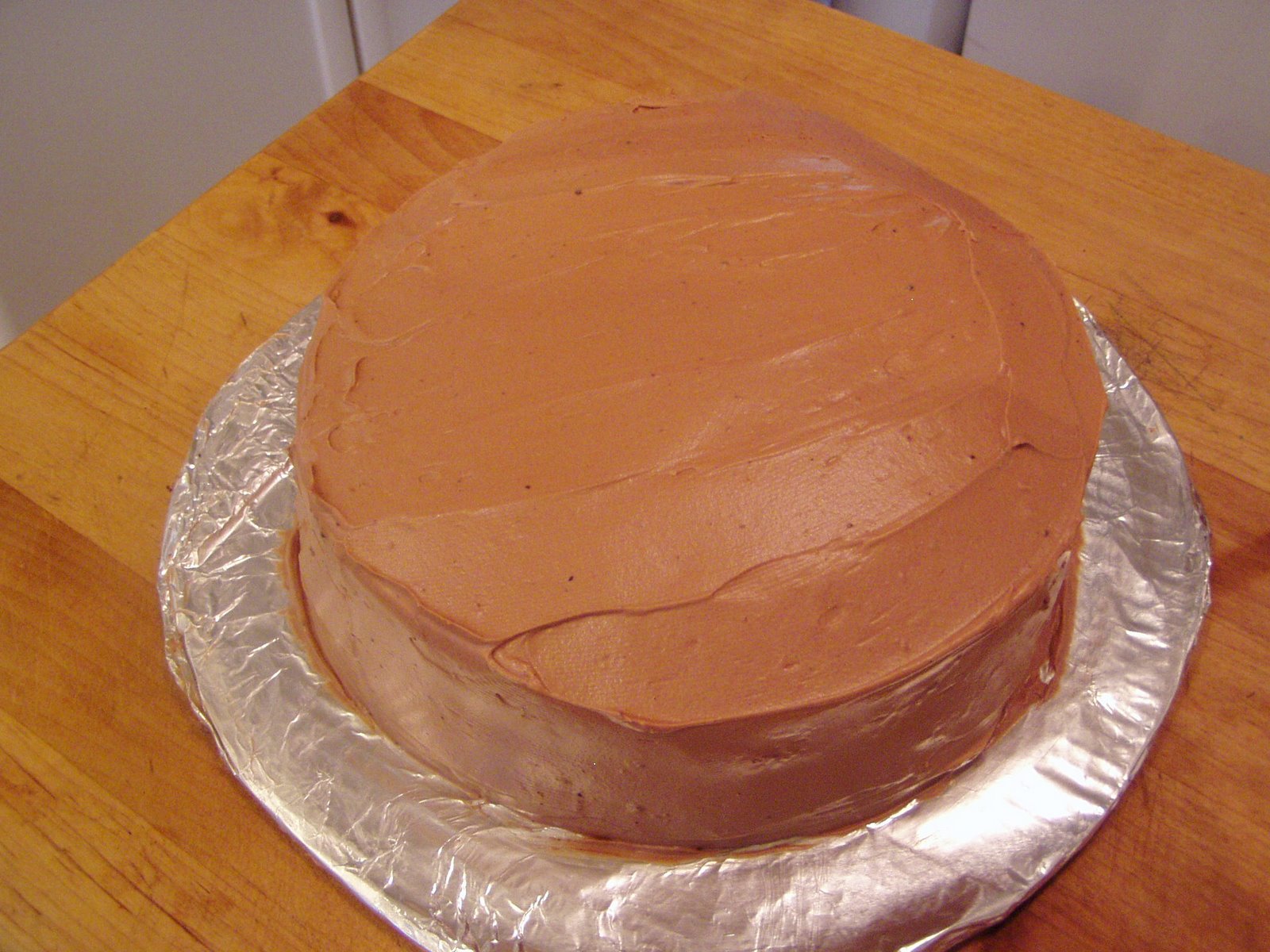
Finally finished the cake last night, which I was making for a silent auction at church. (Do I sound like my grandmother or what?)

I dispensed with Cook’s Illustrated and their Consumer Reports approach to cooking and turned to James Beard’s American Cookery for the chocolate cake recipe. It was the Chocolate Custard or Devil’s Food Cake on page 676–a tender, light cake. Very tender. Especially when you cook it a tiny bit too long, which makes the waxed paper you used to line the pan stick to the firm (but not burned) edges of the cake and cause them to crumble.

But then: Here comes the frosting to SAVE THE DAY!!!

This is a variation on Fanny Farmer’s (1990 version) of Cream Cheese Frosting (p. 600). I love that recipe because it’s incredibly versatile–you can add most any flavoring you like.

Here’s what I did for this cake:

Mocha Cream Cheese Frosting

Frosts a 9″ 3-layer cake

16 oz. cream cheese
1/2 c. butter, softened
3 c. confectioner’s sugar, sifted
2 tsp. vanilla
2 tbsp. strong brewed coffee (espresso would probably work too)
4 oz. bittersweet chocolate, melted

Set aside 1 c. of the sugar. Combine ingredients in a mixing bowl. Add remaining 1 c. sugar until it’s sweetened to your taste.

I don’t care for very sweet frosting, so you may need to add up to 4 cups of the sugar.

Final confession: I actually had to use a mix of extra fine and confectioner’s sugar because I ran out of confectioner’s.

I bet that never happened to Fannie Farmer.

Pigging Out

Check out the lovely pigs you can buy for supper at the Heritage Farms web site. I’m thinking of ordering a quarter of one of these. (Look at their “quarter hogs” for sale and see the Red Wattle.)

At nearly $9 a pound, it’s not the greatest deal, but after reading the latest NY Times artile on the factory farming of hogs on Michael Ruhlman’s blog, going whole hog into sustainably farmed meat suddenly seems like a good idea.