Why No One Cooks Turkey in the Summer

I send Happy Mother’s Day greetings to my mom, who will be glad to know that once again, as always, she is right.

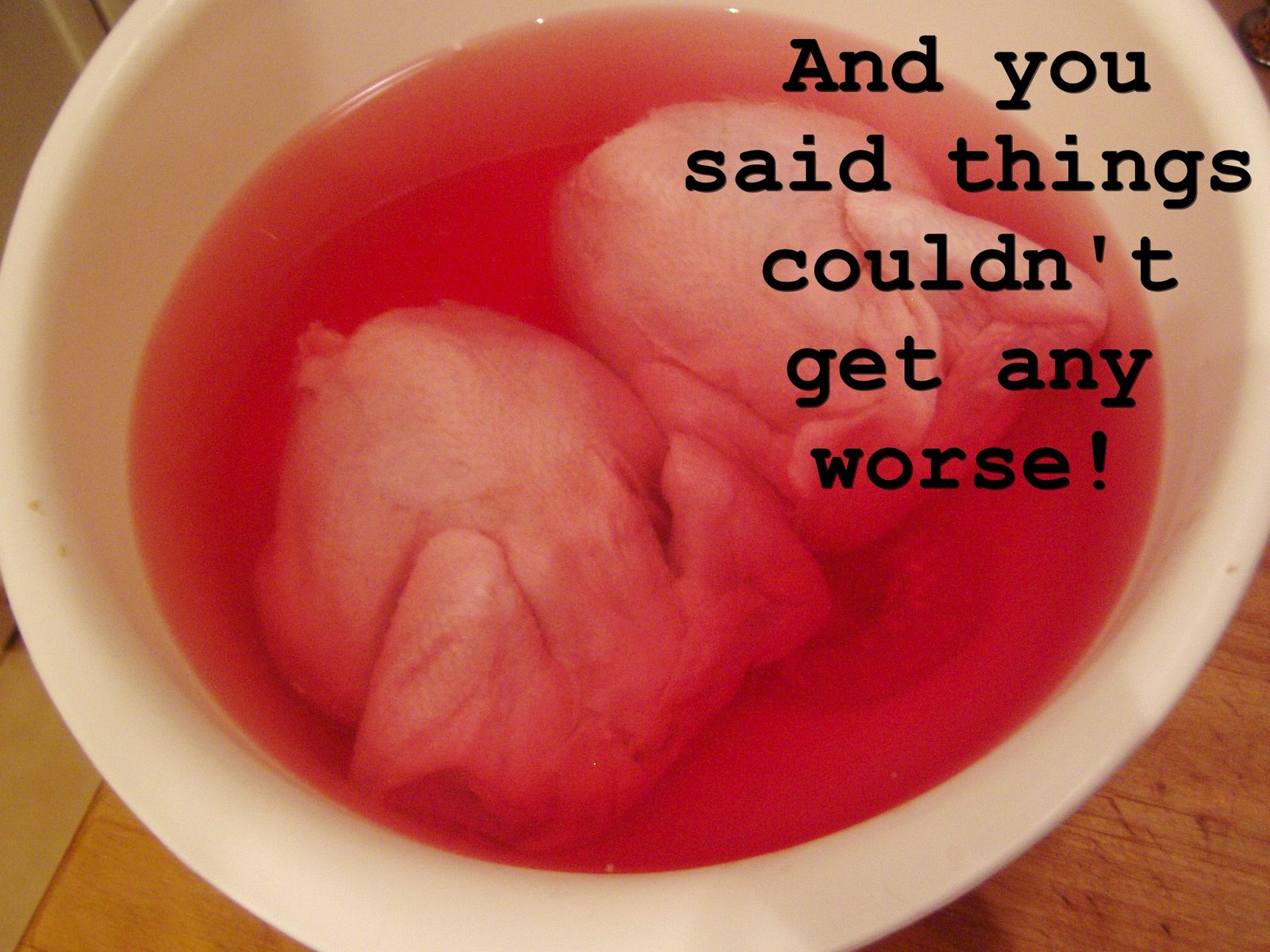
This time, she’s right about turkey. She simply puts her roast turkey in extra heavy-duty aluminum foil and cooks on low heat. But instead of consulting my mother, as I should have, in my inaugural turkey-roasting, I turned to Cook’s Illustrated. They tell you to brine the turkey for 4- 6 hours, which is already too much work. (You’d think I’d have learned after last month’s Cornish Hen Incident.) But I soldiered on, brining the turkey, roasting it in a V-rack on unbearably high heat without foil in an uncovered pan, turning and basting about four times.

It was tender and tasted fine, and it did produce a crispy skin. I give it that. But emerging from the oven, the turkey sat there primly in its V-rack, viruously hovering over the unseemly fat lurking on the bottom of the roasting pan. My mother’s turkeys are earthier birds, lolling about indecorously in a sensual bed of grease. Grease you get to eat when you go to pick the meat off the bones. Grease I did not get to eat yesterday.

Probably just as well, as I could barely squeeze into my pajamas anyway.
Summer Turkey

I’m back from a fundraising trip to Nashville (for the seminary, and not, unfortunately, for me).

And now, in May, with the temperature around 85 degrees, I am going to cook a turkey. And I have never cooked a turkey before in my life.

I will post results as they come in.

And Speaking of Hens . . . .

When you have to move things out of your mother’s house when you’re 41, you really get the chance to go back in time. Dig up old memories. Like my fourth grade 4-H chicken project.

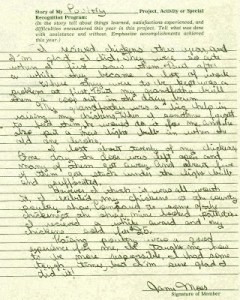
Here’s the story, in my own fourth-grade voice:
Story of My Poultry Project, Activity or Special Recognition Program: (In the story tell about things learned, satisfactions experienced, and difficulties encountered this year in this project. Tell what was done with assistance and without. Emphasize accomplishments achieved this year.)

“I received chickens this year, and I’m glad I did. They were so cute when I first saw them. But after a while they became a lot of work.

“Where they were to be kept was a problem at first. But my grandfather built them a coop out in the dairy barn.

“My grandfather was a big help in raising my chickens. When I sometimes forgot to feed them, he would do it for me. And he also put a new light bulb in when the old one broke.

“I lost about twenty of my chickens. One day the door was left open and many of them got away. And about five of them got stuck under the light bulb and suffocated.

“However, I think it was all worth it. I exhibited my chickens at the county poultry show. Compared to some of the chickens at the show, mine looked pathetic. I received a white award [this is the 4-H equivalent of saying, ‘hey, you showed up, so we have to give you something’] and my chickens sold for $25. [Note: The other chickens sold for about $25 each.]

“Raising poultry was a good experience for me. It taught me how to be more responsible. I had some tough times, but I’m sure glad I did it!”

Those poor Cornish hens didn’t have a chance.

The Briney Waves

Just how long can you brine Cornish game hens before they shrivel up like prunes? On Monday I set out to cook two of them for our supper and started brining them, as the recipe I was attempting suggested.

Then Fred pipes up: “Can we eat now?”

“No problem,” I think. “We’ll have them tomorrow.”

“Tomorrow” we went back to Ikea for more furniture and ate pizza at a place where we had a coupon.

So our hens still sit in the refrigerator in their salt water bath, 48 hours later.

Results later today!

Pizza Art

The reception for Fred’s art show was last night at his studio/gallery. He gave a talk and reminded me again why I married him (because he’s sweet, smart, sensitive, and a wonderful painter).

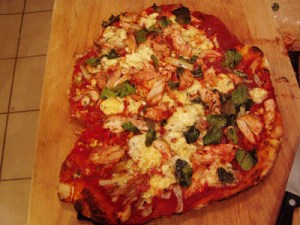
Still, none of this helped the pizza I made on Friday.

EEEEEEEEEEEEEEEEEEEEEK!!!!

I didn’t realize how scary that was until I posted it. Perhaps I should send it to the Saatchi Gallery to put next to the pig in formaldehyde.

Now that no one has any interest in eating this pizza, I’ll tell you what’s on it because despite its dreadful appearance it was QUITE TASTY.

Chicken
Blue Cheese
Spinach
Thyme
Cherry Peppers
Onions

And be careful when you slide the pizza into the oven.

Can anyone tell me how to remove burned blue cheese from a pizza stone?

Very Unhealthy Jicama, Chicken, and Baby Spinach Salad

Healthfulness was bursting out all over in the house last night–occasioned by tightening waistbands and a growing number of clothing items that are not quite as comfortable as they once were.

Right now I can’t think of anything more hateful than the concept of healthy, wholesome food. And yet I had to start back on Weight Watchers yesterday–counting points, making sure I get my vegetables and whole grains and lean meats and dairy–BLLLEEEEHHHH!!!!

And now for a brief digression into our country’s schizophrenic food ideology: Potato chips, McDonald’s, Coke, Twinkies–those are “fun,” “tasty,” “good” foods, but the quality is awful. They’re basically fat, salt, and sugar vehicles, covering tasteless, mass produced, plastic objects whose relation to any living thing has been long since severed. Then we have “healthy” foods–equally mass produced and tasteless, but without the fat and salt to cover up their lack of flavor.

It’s hard, sometimes, to realize that food that’s truly good to begin with will be healthy–vegetables that are fresh and seasonal, meat that hasn’t been factory farmed, and so on. You won’t need to put tons of ranch dressing on local tomatoes in August.

Anyway, despite its healthiness, this salad was actually quite good. FWIW I have no idea if jicamas are in season so disregard above remarks on seasonal tomatoes if they’re not:

Jicama, Chicken, and Baby Spinach Salad (serves 2 as a meal, 4 as a side)

Saute in skillet on medium heat in 1 tbsp. olive oil until translucent:
One medium-sized jicama, julienned (or cut like french fries)

Turn heat off. Add and stir:
1 cherry pepper, minced
2-3 cloves garlic, minced
Salt to taste

Rinse and dry spinach, if necessary (if you see any E. coli lurking on the leaves). Dress spinach with 3/4 of the following dressing, mixed briefly in a food processor or blender:
2 tbsp. olive oil
1 tbsp. salsa
1 – 2 tsp. balsamic vinegar

Add reserved 1/4 of dressing to jicama. Add jicama to salad. Add chopped or shredded chicken as desired. Weight Watcher forced me to leave the chicken off. Fred added grated cheddar cheese to his salad. I hated him for that, just briefly.

Stock Thoughts


I truly, truly believe that stock is perhaps the most underrated cooking necessity on earth.

This is sad, because stock is painfully simple to make:

1. Cook any kind of meat with bones (chicken, turkey, ham, whatever).
2. Put the bones, skin, and leftover bits of flesh in a pot. Cover with water. Cook on low heat for several hours. If you are lazy, or don’t have time, however, you can start on medium high heat until the water is getting hot (don’t boil), then turn the heat to low and cook for an hour or so. It’s still going to be better than canned.
3. Pour your stock through a collander.
4. Make sure a bowl is under collandar–nothing is more unpleasant than watching your stock go down the drain. (I know this from personal experience.)
5. Let stock cool, pour into 1-quart freezer containers and freeze.

When you want stock for your soup, just pop one of those containers in the microwave for five minutes to loosen, then add the stock when the recipe calls for it. Don’t worry–with the heat and all, it WILL MELT. Very quickly. So quickly that if you’re not careful, you’ll end up with incidents like the Cauliflower Disaster below.

You will make all your friends jealous.

The Cauliflower Chronicles, Part II

The cauliflower soup is improving with age, but I’m beginning to forget the recipe. Before I forget, here it is:

2 onions, chopped, sauted in goose fat or bacon
2 thick slices ham, chopped
3-4 cloves chopped garlic
2 heads cauliflower, stems removed, cut into large flowerets
2 quarts goose or other poultry stock
Whole milk or half and half
Fresh sage, salt, and pepper
Okra, sliced

Saute onions in fat on medium heat. Add garlic. Add cauliflower and stock. Cover and cook until cauliflower is very soft. While cauliflower is cooking, heat up ham in separate skillet. When cauliflower is done, puree in food processor. Add remaining ingredients and cook until okra is cooked but still somewhat firm (or as soft as you like it).

Pics to follow.

The Cauliflower Chronicles, Part 1

Despite the, um, burning, the cauliflower soup turned out well. Probably the goose fat leftover from Christmas helped. Here’s how it went down—we will forget the slight scorching incident ever, ever happened.

Here’s Part I of the Cauliflower Soup Chronicle:

That’s the beginning, outside of the cauliflower: goose fat and Prague ham. There’s a QUART of that goose fat, rendered from the goose I cooked over Christmas, five days before my wedding because I wanted to—what? impress my date with my cooking? give myself a nervous breakdown? Anyway, I discovered why goose is no longer as popular as it once was. It’s fabulously delicious, but it cost $65 to feed four people, with nothing except the fat and a couple of quarts of stock to speak of left over. Of course, that fat is reason enough, I suppose, so I shouldn’t complain. And the meat was great. And it took two days to prepare. And it was like one giant turkey thigh and some roast beef rolled into one. And I’ll probably do it again.

Okay, I gotta work on the mailing list for Fred’s art show in March, so I’ll have to finish this saga tomorrow.