Hamburger a la Fred

Upon returning from the beach, the mood in the Wise household has tanked. Hurled from the glamorous freedom of vacation back into the plodding reality of ordinary life and work, we’ve both been a bit downtrodden, even grumpy.

My own irritability has been exacerbated by a sprained ankle I acquired on the way back from the beach–not by slipping on a sundae dropped by a careless toddler at McDonald’s, or in a 12-car pileup on I-40, or even by tripping over the entryway at a rest stop. No, I managed to do this in the car. Sitting down. With my feet up.

After examining my X-rays, the doctor at Duke Urgent Care explained that the damage occurred because of an old injury, an avulsion fracture, in which a ligament had torn and pulled a little piece of bone off with it. I well remembered the injury, from my senior year at Duke in 1987, during a volleyball game held as part of a scholarship competition at Vanderbilt Law School. (I did not win the game or the scholarship. I suspect the committee questioned the sense of a candidate who could not bear the thought of not wearing her brand-new five-inch heels to the interview and so wore the heel on one foot and a splint with a cotton sock on the other.) And the results apparently are still with me, because it seems that the ankle is more susceptible to additional injury–including holding my ankle in a stretched position a little too long.

I’m now splinted and wrapped, able to wear only flat sandals to work, and not really in any shape to stand in the kitchen and cook. So Fred stepped bravely into the breach, offering to try his hand at dinner tonight.

As he did a couple of years ago, the last time he was allowed in the kitchen, he made hamburgers. This time, he consulted Mark Bittman for starters but decided that he wasn’t going to grind his own meat. He used 2/3 lb. ground beef for two patties, added a splash of Worchestershire sauce and salt to each one, and fried the two thick patties with some jalapenos and garlic. We debated the merits of bread vs. bun, and Fred’s preference (sourdough bread) won out because he was cooking. I hate to admit it, but he was right. Served with fresh tomato slices and onion, the flavor of the meat stood out, with the bread a nice complement to t he flavor rather than an overwhelming presence. And we ate them so fast it didn’t have time to get soggy.

I’m still grumpy, but I’m grateful that I have a husband who takes care of me when I most need it.
I’m at the beach this week with the dozen or so friends I’ve been vacationing with for the last 12 years. We’re a group of food lovers, and over the years we’ve had memorable dishes, from an epic production of fried chicken to peach pie laced with bacon fat. (I believe in the goodness of that pie despite what everyone else says.)

Now, though, with only one member of our group under 40, things have begun to change. Suddenly, food issues of all sorts are putting a damper on our once free-wheeling, fat-laden extravaganzas:

1. Following her husband’s 40th birthday party a few years ago, in which he stored a whole pig carcass on ice in the bathtub for a few days, M.H. has, understandably, returned to her early vegetarianism.

2. Janice and her son, Julian, are gluten-free because her doctor has told her that she has the gene that causes celiac disease and that she needs to avoid wheat. (Her husband occasionally refers to the doctor as “that quack.”) She also avoids dairy.

As an aside, I caught Janice giving cod liver oil to poor Julian yesterday. My attempts to infuse humor into the situation: “I can’t believe you’re giving him cod liver oil!” went unappreciated. “It would be better to help rather than hinder the situation here,” Janice said. I decided it was best to leave Julian to the therapist he’ll be seeing in about 15 years.

Janice brings a lot of her own food.

3. Donna and Mara do not eat seafood.

4. Everyone (except me, it seems) has an idiosyncratic aversion of one sort or another, including raw tomatoes, tapioca pudding, mayonnaise, Brussels sprouts, liver, rutabagas, coffee, coconut, olives and mushrooms.

We had for years managed to work around these dietary predilections with minimal fuss and only the occasional blow-up.

But then Shannon and Carol chimed in.

I was planning dinner for our first night and sent an e-mail to the group asking them to remind me of their dietary restrictions. This was a silly idea in the first place, akin to stubbing my toe on purpose or giving myself a series of paper cuts. So I deserve what came next.

Carol wrote back the next day. In sum, her message said that they didn’t eat grains in any form—rice, wheat, spelt, millet, bulghur, you name it–any kind of bean, or dairy. Apparently, she and Shannon have embarked on the Paleolithic diet, in which they attempt to eat like our Paleolithic ancestors, on the theory that this is what humans originally evolved to eat before agriculture stepped in and ruined everything. (Shannon apparently picked it up when he was training for a bike race.) In essence, this means they eat only meat, vegetables, and fruit.

There’s probably no point in commenting on the wisdom of adopting the diet of a people whose average life span was about 35, or on why meat would not be considered “processed” food. All I can really say is that approaching dinner, I faced the following SAT-like logic problem:

1. M.H. eats seafood, grains, and dairy but not meat.
2. Donna and Mara eat meat, grains, and dairy but not seafood.
3. Janice eats meat and seafood but not wheat or dairy.
4. Carol and Shannon eat meat and seafood but not grains of any kind or dairy.

Our fragile equilibrium had collapsed. Were I to attempt to prepare a meal that took into account everyone’s dietary restrictions, we would be eating only vegetables, fruit, and eggs. And there are only so many omelets you can eat in a week. (Later, I learned that Mara doesn’t eat eggs.)

Poor Shannon and Carol. Over the next several days, e-mails flew back and forth mercilessly, including one in which Rocco declared that he was feeling very out of style as an omnivore and was therefore going to try his hand at dietary restrictions by keeping kosher and requiring us to get separate kitchens for meat and dairy at the beach house.

I wasn’t terribly surprised when Shannon and Carol decided to stay home. They claim it was because they’d just moved and started new jobs and didn’t want to haul two small children on a cross-country odyssey just then, but I know better. They were afraid we’d slip some millet into their vegetables.

On Saturday night, we ate tacos. Everyone was happy.

Cucumber-Avocado Soup

Several events converged in the making of cucumber-avocado soup yesterday.

 A reminder that The Newlyfeds is about the stories and food, not the photos

The first was last month’s family trip to Kiawah Island, South Carolina, where we made our annual pilgrimage to Hege’s. Hege’s is a “brasserie Francais classique” focusing primarily on seafood. (Fred, of course, ordered steak.) On this trip, they offered a cucumber-avocado soup as a special. It was so good that even my seven-year-old niece loved it. The color was the perfect green for this kind of soup but it’s hard to describe exactly what it was–the only thing that comes to mind is a very unappetizing comparison to a 1970s appliance, only about six shades lighter. Or maybe the minty color of a bedspread you’d get at Pottery Barn.

Color aside, the soup somehow managed to taste like neither cucumber nor avocado, but a summer evening, with a dash of cream and chives. (The server claims there was no cream in the dish, but I am sure he lied–see below). I was determined to try this at home.

The second event was the avalanche of produce that is coming out of the nascent community garden at our church, St. John’s Presbyterian.

You can see the cucumber plants in the fourth box from the front. There are a lot of cucumbers buried in those plants–so many that our small congregation can’t quite manage all of them. And there’s parsley, enough to supply the entire city of Durham for the remainder of 2010. 

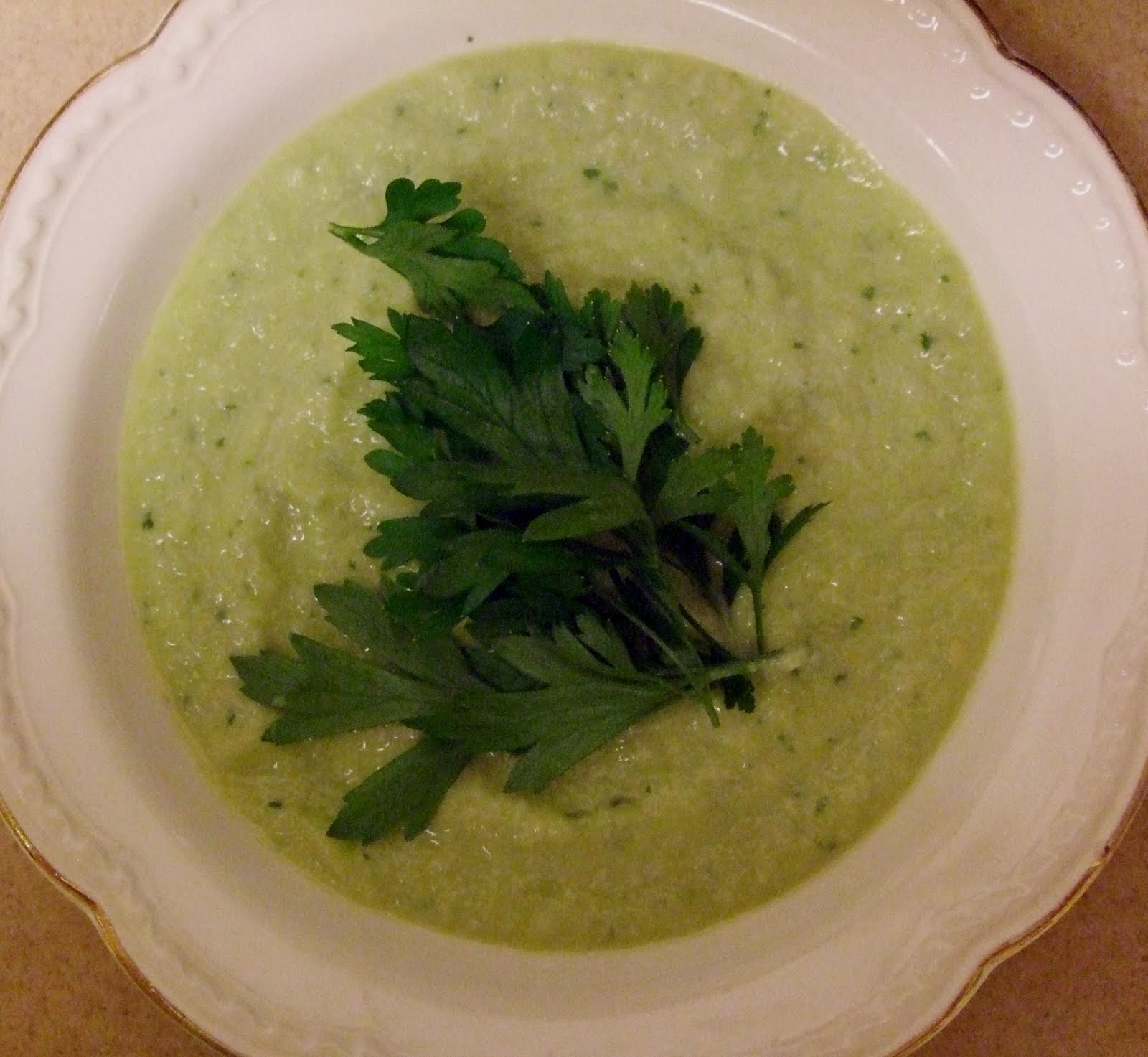
Here, of course, was my opportunity to re-create that spectacular cucumber-avocado soup, only this time with parsley in place of the chives. I was a bit reluctant to replace those chives, since they complemented the other flavors of the soup so well. But I hated to see that parsley go to waste, and there’s only so much tabbouleh that one person can eat.

The parsley was a stroke of genius. As a garnish, it added crunchiness and a gentle undertone, with a hint of creamy pine nut balancing its natural sharpness. And like the original, this soup tasted just like summer.

Cucumber-Avocado Soup

4 servings

4 large cucumbers, seeded and roughly chopped
1 avocado
1 small garlic clove, minced
1 tbsp. Salvadoran or Honduran creme
2 tbsp. heavy cream or half and half
6 – 8 large Italian (flat-leaf) parsley leaves, plus generous amounts for garnish (about 1 cup)
2 mint leaves, torn (optional, but these smooth out the flavor)
Salt to taste
Water

Scoop avocado from peel and remove pit. Puree cucumber, avocado, and garlic in food processor until finely minced. Add remaining ingredients except for water and pulse in food processor a few seconds at a time until ingredients are combined. Add water until soup reaches the consistency of thin grits or whatever you prefer. Garnish with very generous amounts of parsley.

The soup is best if served immediately. The avocado will create a brownish film on top of the soup if it is kept overnight.

Note: The creams and avocado make this a rich dish, and I noticed a bit of greasiness around my mouth after each bite that some might find unpleasant. To correct this I would suggest reducing the Salvadoran creme to a teaspoon and substituting half and half or whole milk for the heavy cream, or even omitting these and adding chicken broth until the dish is the proper consistency. I did not have chicken broth on hand when I made this, and that may well be what Hege’s used to get the right flavor instead of cream. But I still think the server lied.

Fred turns 50

Fred turned 50 earlier this month–on the Fourth of July, to be exact. The event was marked with a weekend of Fred-filled activities. These included lunch at the North Carolina Museum of Art  . . .

. . . with his adoring wife . . .

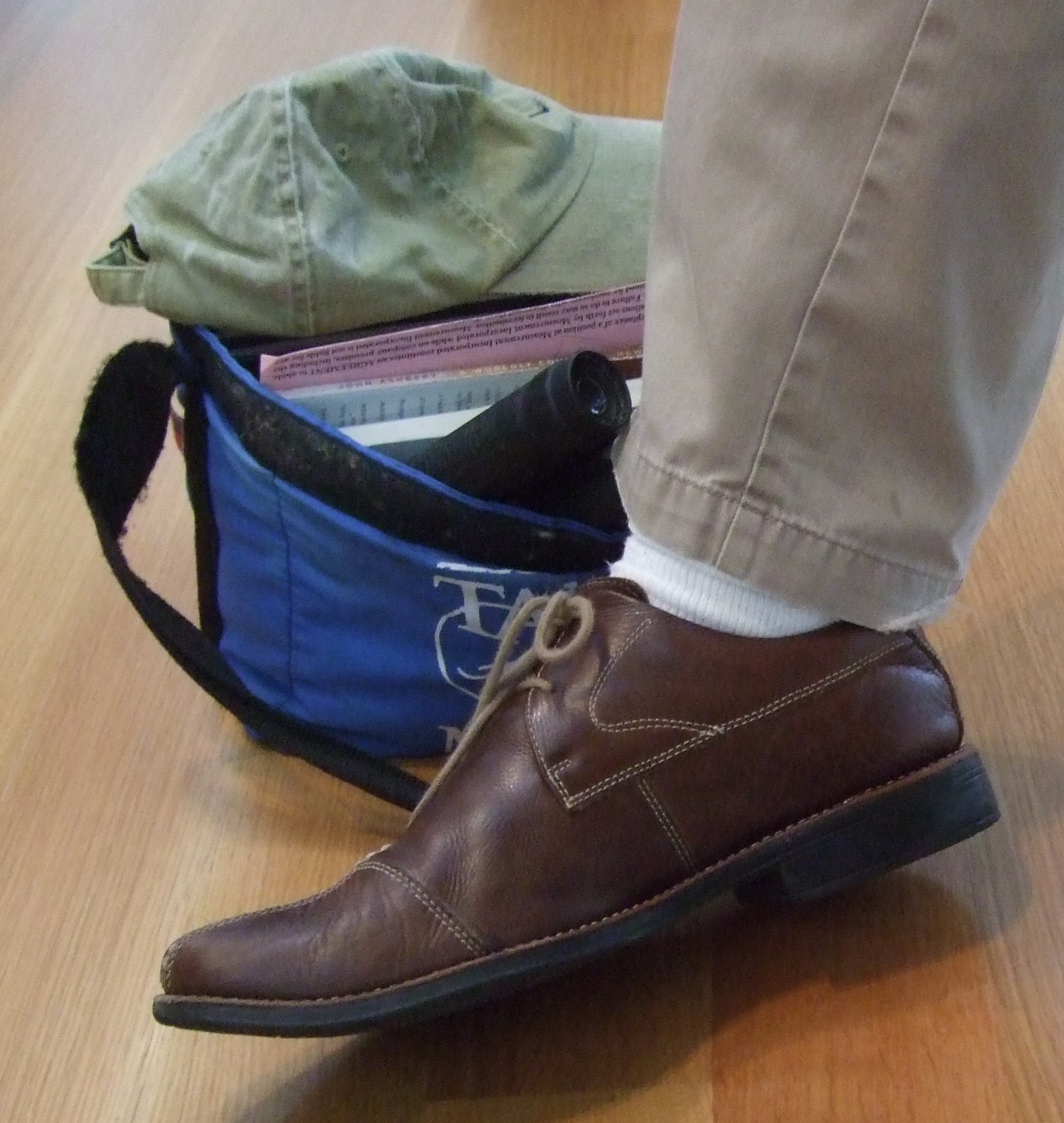
. . .  who tried to ignore the fact that he was wearing white tube socks with Italian shoes and carrying books in a battered lunch bag with a prawn on it.

Of course, there were fireworks at the Gwinnett Braves games–I mean, at the Bulls game where they played the Braves.

(Aside: It’s important to understand the role that the Braves play in Fred’s life. At about ten o’clock last night, I was reading in bed when I heard Fred cry out, “Oh God!” from the study, followed by a stream of worried muttering.

“What’s wrong?” I called out anxiously, concerned that he’d received news of a death in the family or that some tragedy had struck a friend.

“It’s 10 – 5 at the bottom of the ninth and the Braves have nearly wrapped it up but this stupid pitcher is throwing BALLS! JUST THROW A STRIKE, WILL YOU? For cryin’ out loud!”

I returned to my book.)

The weekend was capped off with dinner at Angus Barn, the Triangle’s go-to place for an old-fashioned steak dinner with a martini. Even Fred couldn’t finish the 15 ounce Porterhouse he ordered, so it ended up in a sandwich the next day. 

Fred is very excited about the new venture into cooking and food photography that this image represents. He chopped things and assembled them. Perhaps one day he’ll venture into turning on the stove.

But I’m glad he’s spent 5 of his 50 years with me, and I’m hoping for many more.

Roasted Persimmon Salsa

In addition to the loss of our beloved Louise, June has been a trying month for The Newlyfeds. That’s primarily because my work takes me traveling across the country to Annual Conferences of the United Methodist Church. There’s generally not much to report food-wise on these trips, unless you fantasize about hotel banquet meals.

Perhaps this overabundance of salad topped with chicken breast, combined with our current explorations of Durham’s taqueria scene, has led me to explore spicier food–along with the prodding of my dear neighbor, Melissa. During one cat-sitting stint for us, she looked over my cookbook collection and upon our return declared, “Your cookbooks seem kind of outdated for someone who writes about food.”

I tried to explain that a) I liked to collect older cookbooks and b) we were too cheap to buy new ones. She raised her eyebrows, looking at me just as my mother did about 40 years ago when I tried to tell her that it was Cindy Riden’s idea to “decorate” my bedroom furniture in magic marker and crayon.

“You can buy used cookbooks on Amazon for practically nothing,” she said. “Come over to my house and look over some of mine. You can even borrow them.”

That’s how I ended up with her copies of Rick Bayless’s Mexico: One Plate at a Time and Mexican Kitchen–two thorough, engaging books that have set me off on a new journey through Mexico’s foodways. Melissa was finally able to pry the books out of my greedy, grasping fingers after several weeks, but fortunately Fred stepped in and bought me copies for my 45th birthday on June 16, along with the newer Salsas that Cook.

I’ve especially enjoyed the salsas, which have introduced me to the technique of roasting garlic and peppers in a skillet to bring out their flavors, then adding to roasted tomatoes.

Inspired by these and by the purchase of some persimmons on a trip to Atlanta, I came up with the recipe below. It’s reminiscent of peach or mango salsa, but not treacly as those can be. Instead, it offers just a hint of sweetness followed by a considerable kick.

If you’ve never tried persimmons, they’re common in the South though not always easily found in the store. The trees grew wild on our farm in Tennessee. These wild ones must be very ripe before they’re eaten; unripe, the taste resembles lemon infused with chalk. The ones you’ll find in stores are a little more forgiving, tasting a bit like a not too sweet apricot with hints of orange. For this recipe, use the ripest ones you can find, or let them ripen on your counter for a few days–the sweeter persimmons help balance the acidity of the tomatoes.

Roasted Persimmon Salsa
 
2 whole unpeeled, very ripe persimmons (available in most stores)
2 whole unpeeled tomatoes
1-2 whole jalapeno peppers
3 whole cloves unpeeled garlic
Salt to taste
Chopped onion and fresh chopped cilantro for garnish

Set oven rack about 6 inches below broiler and turn broiler on high. Place persimmons and tomatoes on baking sheet with rim. Roast in oven about 6 minutes on each side until blackened in spots. Remove and let cool on sheet.

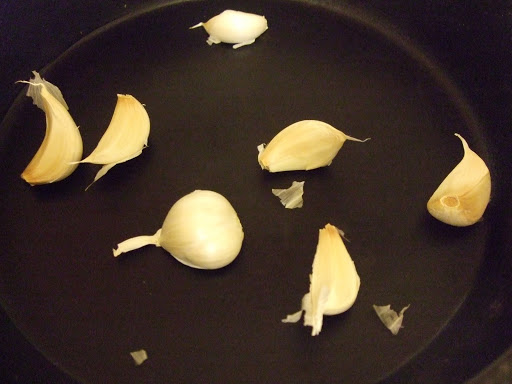
Meanwhile, place garlic and jalapenos in ungreased skillet on medium high heat. Roast on stove top until blackened in spots, about 15 minutes. Set aside to cool.

Remove stems from jalapenos and peel garlic. Chop in food processor or blender a few seconds, until minced. Cut out tops of persimmons and tomatoes and discard; peel if desired. Add to jalapenos and garlic in food processor or blender, along with juice. Chop coarsely and salt to taste. Garnish with onion and cilantro if desired.

Good-bye, Louise

Our dear cat Louise, featured so often in pages of this blog, died unexpectedly yesterday morning. The vet discovered fluid in her lungs when we took her in Friday afternoon, and by Saturday morning we decided it would be best to have her euthanized. We trust that God is giving her lots of tuna, that she is getting good lap time on a regular basis, that she is chirping happily in a warm sunny spot, and that she is finding many birds and voles to chase–birds and voles that misbehaved horribly in this life, and are getting their just desserts.

But I miss her, my friend and companion of 14 years. She sat on my lap and chirped through a broken engagement, three major moves, a new marriage, and a career change. She was always there to remind me that a creature deserves and therefore should demand love and respect, that naps are a necessary part of life, and that you need to pay attention to the things you love no matter how busy you may be.

Good-bye, Louise.

Six weeks old
With her favorite toy as a kitten

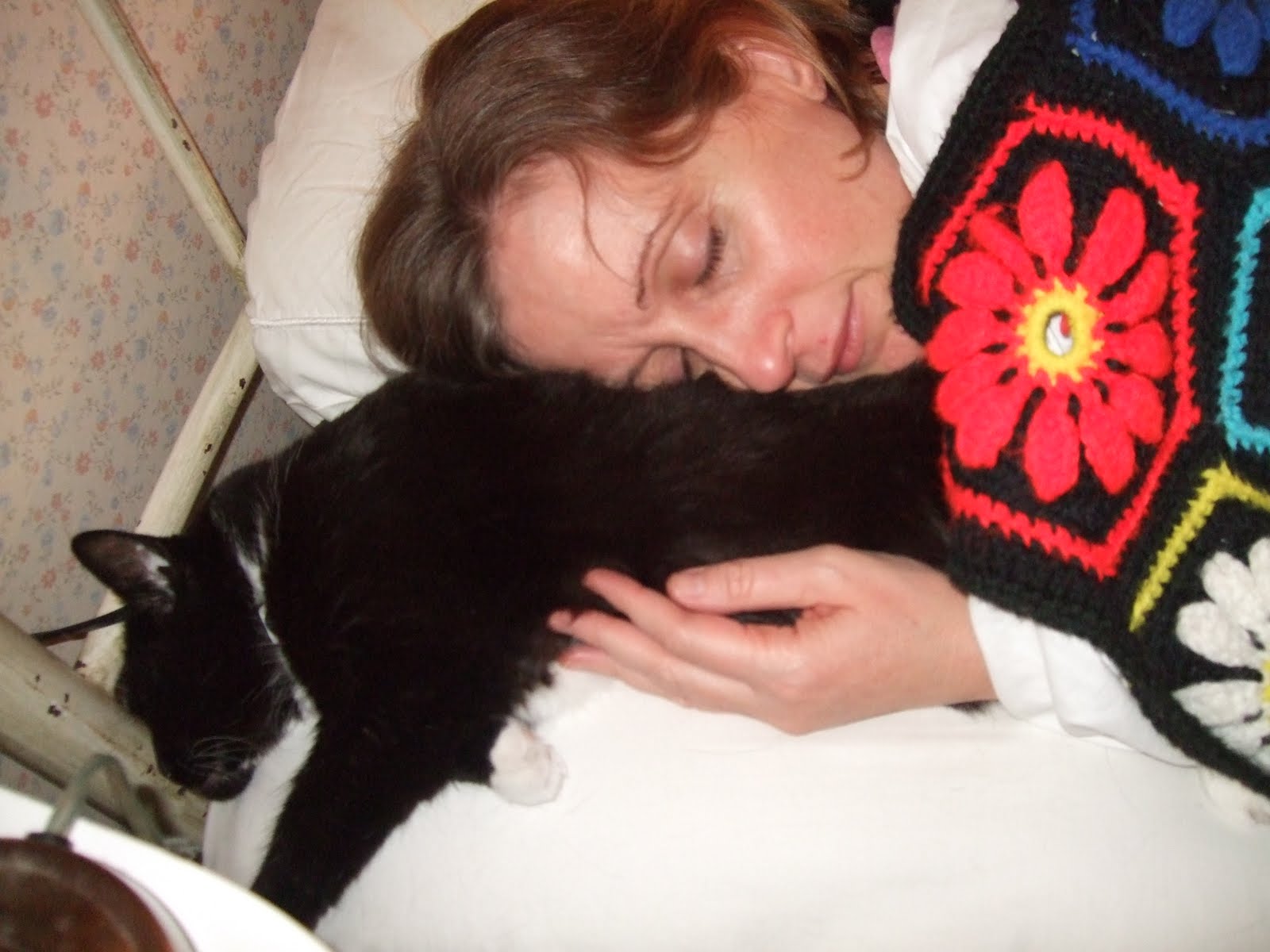
Protecting her human at night
Helping to write the blog

My sweet friend

Red Turnips, Scallops, and Pasta

I continue to grovel for nearly killing Fred last week, and yesterday some some scallops offered a chance for redemption. (They came from Walking Fish, our community sponsored fishery, which I’ve raved about so much in this blog that they need to start paying me.)

My first thought was to serve them over pasta, with a side salad that included this bunch of red turnips, picked up at the Durham Farmers’ Market on Saturday and so in desperate need of eating.

The turnips are white on the inside, laced with red, and with a thick scarlet ring around the edge when sliced. They would have been beautiful in a salad, especially with their greens mixed in. Unfortunately, though, they tasted like–turnips. Really sharp turnips. So cooking was in order, and I considered serving them mixed with the scallops.

But I dispensed with this idea when I saw the scallops, just a few hours out of the ocean.  They were everything you hope for in a scallop–sweet, buttery, tender little pillows that needed only a quick visit to the skillet. They deserved star billing, not to be sullied by any association with pasta or, God forbid, turnips.

Thus the turnips, with their greens, ended up on top of the pasta. The idea was inspired in the vaguest sort of way by a visit to Liguria, Italy, in 1994, when I first had potatoes and pasta with pesto–the moment I came to understand that anything, even another starch, could be served pasta and it would be good.

My scallop technique comes from Cook’s Illustrated’s book The Best Recipe, though really the only technique you need for scallops is not to overcook them. The recipe includes a nice sauce made from the pan juices, and it occurred to me that a variation on that sauce would be good with the turnips. (“Variation” may be the wrong word here, since I left out everything in the recipe except butter, white wine, and parsley and added turnips, garlic and turnip greens.)

The meal below looks more complicated than it is. I’ve written out the recipe in some detail because the timing is critical–but the whole thing took only 30 minutes from the moment the ingredients came out of the refrigerator.

And it’s worth it. Fred declared this one of the best meals we’ve had–though he thought the addition of sausage might help. Only the fact that I put him in the emergency room last week kept me from killing him right there.

Scallops, Red Turnips, and Pasta

Serves 2

Scallops
14 medium to large scallops
1 – 2 tablespoons butter
Salt and pepper

Turnips and Pasta
6 small red turnips, washed, greens and ends trimmed, sliced into 1/2″ wide strips
Greens from turnips, stems trimmed, washed, dried, and cut into 3″ wide strips
2 large cloves garlic, minced
1 – 2 tablespoons butter
1/2 – 1 cup white wine
Fresh chopped parsley for garnish (about 1/2 cup)
1/2 lb penne pasta
Butter and salt for pasta

This recipe goes quickly once you begin cooking, so it is important to have everything ready.

1. Prepare vegetables and set aside.
2. Set scallops out on a plate and salt and pepper to taste. Set out additional clean plate, with foil to cover, for cooked scallops.
3. Put salted water for pasta on to boil. (Follow package directions.)
4. Heat large skillet on medium high heat for about 2 minutes. Once skillet is heated, add butter and swirl until bottom of skillet is coated. Cook until butter is lightly brown, a few minutes.
5. Add scallops quickly, one at at time. Cook for 1 minute. Turn individually and cook for an additional minute. You want to undercook the scallops a bit, as they will continue to cook a little on the plate. Turn off heat and transfer scallops to plate. Keep in warm place until ready to serve. (Covered on top of or near the stove is fine, or in a warming tray on the lowest possible heat.)
6. Watch the pasta water while you are preparing the other ingredients and add pasta to water once it comes to a boil. Cook according to package directions and keep an eye on it so it doesn’t overcook. When pasta is done, drain it, return to cooking pot, add butter and salt, and cover until ready to serve.
7. Return heat on skillet to medium. Add 1 – 2 tablespoons butter until melted. Add wine, enough to cover bottom of the pan, and scrape bottom to remove brown bits. Add turnips and salt to taste. Cover and cook until just tender, about 5 minutes.
8. Add greens. Cook an additional 2 – 3 minutes, covered, until greens have just wilted.
9. Remove lid from turnips and continue cooking just a few minutes more. Serve turnips over pasta and garnish with parsley, with scallops on the side.

In which I nearly kill Fred

Last week, Fred triumphed in a marital victory of epic proportions. On Wednesday morning, he pointed out to me a red spot on his waist, just at the top of the thigh bone, about an inch or so across.

“I think I need to go to the doctor about this,” he said. “It looks like it’s getting infected, and I think my lymph nodes are swollen.”

I peered at the spot. “Oh for heaven’s sake,” I scoffed. “It’s just an infected mosquito bite. That’s why your lymph glands are swollen. They swell up even for regular mosquito bites. If it starts to spread go to the doctor.”

“Are you sure?” Fred said.

I rolled my eyes and made the sort of face you might make at a small child pestering you to fix a scratched finger. “Of course I’m sure. You’ll be fine.” I am always sure, since I am always right.

That was the end of the story, I figured–except, of course, for getting a good laugh out of it with my female colleagues at work. What big babies men are! we said. Running to the doctor over a little infected mosquito bite! HAHAHAHAHA!

That night, as we were getting into bed, I said smugly to Fred, “I take it your bite hasn’t gotten any worse?”

“It still itches,” he replied, “but I haven’t checked it since this morning.”

“Let’s take a look at it then.” I figured we might as well put an end to this.

Fred pulled down his waistband. “It looks like it might be a little redder,” he said.

In that moment it dawned on me that Fred is no baby. The spot was not “a little redder.” It had grown about a half inch in diameter and turned a fiery scarlet. Worse, a pinkish swelling, about a foot or more across, had spread across his groin, waist, and thigh.

In that moment I remembered the inch-long splinter Fred had left in his thigh for over a month, which got infected and which he treated only when I made him go to the doctor.

“I guess I should go to the doctor tomorrow,” he said.

“No you will not! We are going to the emergency room right now!”

We’d recently had a friend hospitalized for just this sort of thing–a rapidly spreading redness on this skin that quickly developed into a nasty MRSA infection (a superbug that is resistant to multiple antibiotics). Fred, it turns out, had the same thing that set off our friend’s MRSA infection–cellulitis, a bacterial infection of the skin that can spread rapidly. The bite, which Fred later revealed had been there for a couple of weeks and had been growing steadily worse, probably came from a spider.

We were lucky to get  in and out of the emergency room in a little over three hours. I felt terrible for dismissing Fred’s worries earlier. I felt even worse thinking about the bill we would get for the emergency room visit. I felt still worse thinking that if I’d listened to Fred, we would be out only a $30 co-pay for a visit to urgent care and would not be sitting in Duke’s emergency room at 2:00 a.m.

As the doctor was writing out the prescription for some powerful antibiotics, I tried to think of something that would get me out of a lifetime of groveling, that might somehow indicate that I had not pooh-poohed Fred’s troubles in vain.

“So if we didn’t treat this,” I offered, timidly, “would it just resolve itself? I mean, is this the sort of thing that might clear up without going to the doctor?”

The doctor looked up from his paperwork. “Oh no,” he replied cheerily. Clearly, he was on Fred’s side. “He would die. The infection would get into his bloodstream and become septic. That’s why antibiotics were such an important development. This used to kill people all the time!”

Happy to have set our minds at rest, he handed us his paperwork and breezed out of the room.

Fred is recovering well, and he is too kind to gloat. But let’s just say he’s getting fed very well these days. I had intended to post a recipe for the lamb dish I made for him the next night, but frankly it didn’t turn out very well. But there will be plenty more, since I will be paying for this for the rest of our life together. And since I’m awfully glad he’s here.

Pupuseria y Taqueria Orellana

Fred pretends to be adventurous. After all, he’s the artist–the one who moved to New Mexico on a lark to make his life as a painter; the one who likes to horrify me by wearing white athletic socks to social events; the one for whom “CD investments” means spending too much money on jazz recordings in the late 1990s.

But the truth came out on a recent Sunday venture after church, when we decided to eat out before running some errands. Driving away from the service, I said, “Why don’t we stop at one of those little Mexican restaurants on Roxboro?”

Fred squirmed–actually squirmed–moving back and forth in his seat. “Which one?” he said, fear coming in to his eyes.

“I was thinking about that little place right after the church on the left.”

Silence.

“You don’t want to go,” I said. “Why?”

“I don’t know,” he said. “It’s just outside my comfort zone.”

“What do you mean? Are you afraid you’ll order something that tastes bad?”

He thought for a minute. “I’m afraid there won’t be anything I recognize on the menu.”

“They’ll have carnitas,” I scoffed. “All Mexican restaurants have carnitas, and you always like that.”

Poor Fred was trapped, and he knew it. If he refused, he’d lose his cachet as the zany artist, the free spirit eager to seek out new experiences. I had him.

Thus we found ourselves pulling in to the parking lot of Pupuseria y Taqueria Orellana (5300 N. Roxboro Rd; 919-471-3299).

To be fair to Fred, it’s a stretch to describe this place as a restaurant. The dining area is in the back of a convenience store featuring Mexican and Latin American products. It consists of an order window, several colorful plastic booths, a large-screen TV, and a fascinating stone fountain with potted plants set up along the back wall in an empty refrigerated case, shelves and doors having been removed. With the exception of the fountain, it’s a lot like the fast food places you’ll find attached to a gas station at an Interstate exit.

Unlike a fast food joint at a gas station, though, the food here was fresh, clearly prepared to order. Much to Fred’s horror, there were no carnitas on the very short menu, which kindly offered some English translations. But he found comfort in a miraculous sandwich, a torta de carne asada. This featured thin slices of spiced meat on an enormous bread roll good enough to be homemade: white on the inside, dark brown and crusty-soft on the outside. It also included generous amounts of mayonnaise, lettuce, tomato, jalapenos, and “a special cheese”–a soft, mild white cheese I’m afraid I can’t identify.

The sandwich calmed Fred. Here were recognizable items–meat, bread, jalapenos, cheese–and he wasn’t being forced to speak Spanish. With his anxieties under control, I was able to turn my attention to my own order–tacos with tongue (lengua), cabeza (pig’s head), and al pastor (spiced beef).

These were wondrous creations. Each was covered in neatly diced onion, cilantro, a slice of avocado, and fresh limes. The salsa–a sauce in the traditional Mexican sense, not our American tomato-based tortilla dip–was thin, sharp and vinegary. The meat was tender and nicely seasoned. (There were, by the way, plenty of offerings for the less adventurous: chicken, carne asada, chorizo).

We also enjoyed a tamale, which resembled a giant hush puppy with a moist, cake-like interior, and a pupusa de queso. There’s a nice description of the pupusa here: it’s a Salvadoran dish consisting of a corn tortilla stuffed with a variety fillings, such as meat or cheese. The pupusa de queso here included Salvadoran and mozzarella cheeses. I’m sure mozzarella is not native to El Salvador, but it worked nicely in combination with the slightly sour Salvadoran cheese.

Fred was happy when we left. His response the next Sunday was predictable. “Can we stop at that place again?”

Jicama and Watermelon Radish Salad

I regret to report that my sweet potato recipe did not win the contest. God only knows whether I’m getting my just desserts for not paying attention to the sermon, or whether retribution is in order for the contest judges, or whether God is too busy with a few other things to worry about than who wins the North Carolina Sweet Potato Recipe contest.

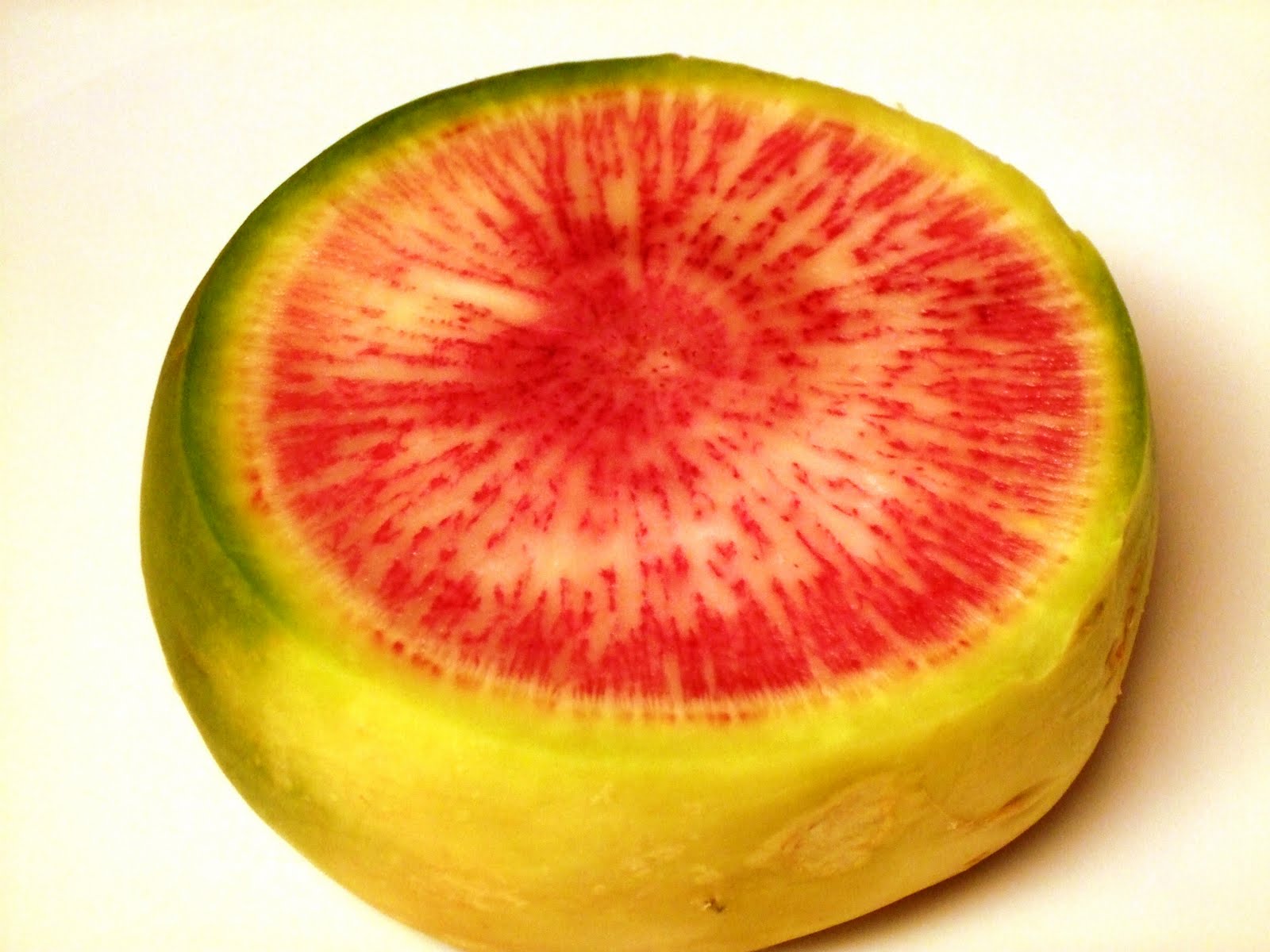
So–off to other vegetables. Recently, I was thrilled to pick up this beautiful watermelon radish.Though it is indeed large. it’s not actually the size of a watermelon; it’s closer to your average orange. You can see, though, where it gets its name. 

Apparently this radish is a type of daikon, but I didn’t spend enough time investigating to find out if that is true. There also appear to be many different varieties. Apparently most of these are actually available in the fall rather than the spring; I’ll start looking for them at the Durham Farmers Market.

Descriptions of the watermelon radish on the Internet say that it’s slightly sweet. This was not the case here. It tasted more like a typical radish–sharp and crisp. So I decided to pair it with jicama, which is sweeter and milder, and added a South American twist by including chili powder. (The chili powder idea came from a dinner party I attended years ago, when the host served mangoes covered in it.)

The result was a nice mix of sweet and sour. I’ve tried it with regular radishes and apples since, with good results.
 
It seems unlikely that North Carolina’s watermelon radish farmers have developed a contest, but if they did I am certain this recipe would win.


Jicama and Watermelon Radish Salad

1 watermelon radish (or other radish of your choice), cleaned and cut into 1/2″ pieces
1/2 large jicama, peeled and cut into 1/2″ pieces
1/4 cup sugar
1/4 cup white wine vinegar
1 tbsp. honey
2 tsp. chili powder
1/2 tsp. ginger
1/4 tsp. cloves
1/4 tsp. allspice