Why There’s the Internet

Two minutes after finishing the post on cranberry beans below, I thought, “Why not see what the Internet has to say about this?” Here’s what I discovered:

“Cranberry beans are rounded with red specks, which disappear on cooking. . . . According to the USDA, the American ‘cranberry bean’ is the same bean as the Italian ‘borlotti’ and, as a matter of fact, a large percentage of the ‘borlotti’ beans sold in Italy are actually ‘cranberry beans’ imported from the U.S. Another name for this bean in the U.S. is ‘French horticultural bean’. If you can’t locate cranberry beans, an acceptable substitute is the pinto bean, and a second (but not as close) substitute would be red kidney beans.”

Someday, I will learn to read instructions.

Not as Cranberry as We Would Have Liked Beans

We discovered these cranberry beans at the Farmers’ Market recently. Since we had never seen them before and they looked weird, we of course had to try them.

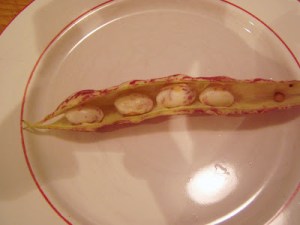
At first I thought we would end up with a big bowl of something that resembled alcoholic green beans–you know, little splotchy red faces staring up at you. You can see why from the picture below:


But when I did a taste test, I realized that the hulls resembled a cross between the bottom of my running shoe and a celery stalk. So it dawned on me that perhaps these were beans that were meant to be shelled. And lo! look at the beautiful beans in there!

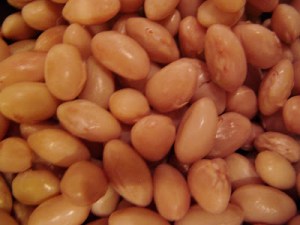
And how gloriously speckled and . . . and . . . cranberryish they were when they were all hulled, waiting to be cooked.


Thinking it would be better to keep things simple, I decided just to cook them in salted water and then figure out where to go from there. I boiled them for a minute or so, then turned the heat down to low for about 45 minutes until they were tender. My heart went thump-a-thump as I lifted the lid to see the final result. What possibilites for beautiful presentations would reveal themselves! How wonderful it would be to have those little red speckled beauties nestled in a salad–maybe even with dried cranberries!

But, as is so often the case, my fond hopes were dashed. Cooked, the beans looked like . . . navy beans, white beans–every other ordinary bean you’ve ever had. They tasted like . . . beans. If you pinned me down I’d say they’re a cross between a pinto and a lima but certainly not a navy and cranberry (as I’d hoped).


I’ll serve them in a salad with olive oil, tuna, and salt. Just like I do with navy beans.

Hulga’s Vegetarian Collard Greens

Hulga’s comment on the kabocha squash post, asking for a vegetarian collard green recipe, deserves its own post.

Hulga, here’s what I do.

Vegetarian Collard Greens (makes 4 -6 cups)

Get enough collards to fill an 8 qt. stock pot. Rinse and dry. Remove stems (if desired) and tear or chop into 2 – 3″ pieces.

Ingredients:
2 large onions, chopped
6 – 8 cloves garlic, minced
1/4 c. sesame oil, or 1/8 c. sesame oil and 1/8 c. chili sesame oil
1/2 c. water
Tabasco sauce to taste (omit if using chili sesame oil)
Salt to taste
1/4 c. white or red wine vinegar

In 8 qt. or larger stock pot, saute onions in sesame oil on medium heat until translucent. (If using chili sesame oil, saute in regular sesame oil and add chili oil after onions are cooked.) Add garlic and stir. Add collards and water. Salt well. Cover and cook on medium heat, stirring collards occasionally, until collards are just wilted. Add Tabasco and vinegar. Continue cooking, covered, until collards are soft (or whatever consistency you prefer)–I cook mine at least 3o minutes. Correct seasonings and serve.

As much as I hate to admit it, I like these just as well as their porky counterparts. Enjoy.

As for the kabocha squash: It’s not in season here either. It’s been sitting on my countertop since February.

And the Pork, You Ask?

Perhaps avid readers will recall that in an earlier post I mentioned that we had pork chops on hand for future use. Perhaps you wonder, “What tasty concoction did she come up with for those?”

Well, dear readers, our pork chops were not all we had hoped. I fried them in the lard, and while the lard did produce a fine texture (Joey, I restrained myself from using the word “lovely” there just for you)–the spice rub left a great deal to be desired. (For the record, it consisted of cumin, coriander, cinnamon, salt, and pepper. Might have worked with some chipotle pepper thrown in.)

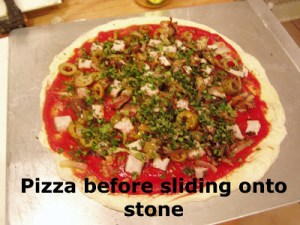
So, hoping to redeem the sad bits of pork hanging around in my fridge, I tried chopping up the leftover chops and putting them on a pizza. But in case you were wondering: pork, carmelized onions, olives, fresh oregano, and cheddar cheese do not go well together. The pizza wasn’t bad–just not . . . great.

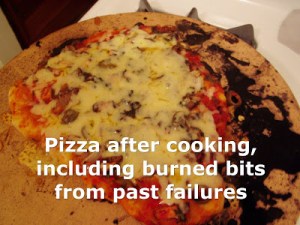
Plus my utter incompetence at making a pretty pizza was, once again, made painfully obvious:

Can someone tell me how to get burned cheese off a pizza stone?

But Then There Was the Kabocha Squash

So I didn’t get my turkey fat. But–bonus for your vegetarian kids, Cheryl!–I did make a lovely side dish with kabocha squash, pictured below.

Kabocha hails from Mexico and is probably closest in appearance and taste to acorn squash. Since the beauty of yellow squashes (I don’t think that’s the plural but it’s a lovely word, isn’t it?)–since the beauty of yellow squashes is that they are practically interchangeable, you don’t even need to have kabocha squash for this. Pumpkin, butternut squash, or acorn squash would do nicely.

Yellow Squash and Potatoes (serves 4-6)

2 kabocha or acorn squash, or 1 butternut
2 large baking potatoes
2 large onions, finely chopped
6 cloves garlic, minced
1/4 tsp. cayenne pepper
6 tbsp. butter
1/4 – 1/2 c. half and half
Salt and pepper to taste

Preheat oven to 350. Cut squash in half and remove seeds with spoon. Brush with olive oil. Roast, cut side down, for 30 minutes or until very soft.

While squash is in oven, peel and quarter potatoes. Cover with salted water in large pot. Cover and cook on low heat until soft.

While potatoes are cooking, melt 3 tbsp. butter on low heat in small skillet. Increase heat to medium and saute onion in butter until translucent. Turn off heat, add garlic and cayenne pepper, and stir until mix is coated with pepper.

Scoop squash out of shell and place in bowl. (If there are any hard spots remaining, add to potatoes in the last few minutes of cooking.) Drain potatoes. Add squash, onion mix, butter, 1/4 c. half and half, and plenty of salt and pepper. Mix with electric mixer until consistency is that of mashed potatoes. Add more half and half and seasonings if needed.
Why No One Cooks Turkey in the Summer

I send Happy Mother’s Day greetings to my mom, who will be glad to know that once again, as always, she is right.

This time, she’s right about turkey. She simply puts her roast turkey in extra heavy-duty aluminum foil and cooks on low heat. But instead of consulting my mother, as I should have, in my inaugural turkey-roasting, I turned to Cook’s Illustrated. They tell you to brine the turkey for 4- 6 hours, which is already too much work. (You’d think I’d have learned after last month’s Cornish Hen Incident.) But I soldiered on, brining the turkey, roasting it in a V-rack on unbearably high heat without foil in an uncovered pan, turning and basting about four times.

It was tender and tasted fine, and it did produce a crispy skin. I give it that. But emerging from the oven, the turkey sat there primly in its V-rack, viruously hovering over the unseemly fat lurking on the bottom of the roasting pan. My mother’s turkeys are earthier birds, lolling about indecorously in a sensual bed of grease. Grease you get to eat when you go to pick the meat off the bones. Grease I did not get to eat yesterday.

Probably just as well, as I could barely squeeze into my pajamas anyway.

Summer Turkey

I’m back from a fundraising trip to Nashville (for the seminary, and not, unfortunately, for me).

And now, in May, with the temperature around 85 degrees, I am going to cook a turkey. And I have never cooked a turkey before in my life.

I will post results as they come in.

Fred Fries

Fred doesn’t really cook, but when it comes to frying he has finely honed instincts that rival that of the greatest chef. Here he is holding the fabulous French fries he made on Saturday.

That’s his grandmother’s Dutch oven to the left, which seems to help in the process.

Here’s what he does:

1. Peel and cut potatoes to desired size and shape. Place in pot of water to rinse off starch. Drain.

2. Heat oil until very hot. Place potatoes in hot oil and cook until just soft but still light in color.

3. Remove fries from oil. Drain. Replace in oil and fry until light brown. Or, as Fred puts it: “You have to observe the surface texture of the fry, ” he says. “You wait until the texture ceases to be smooth and becomes a little granulated. It’s more about the texture than the color.”

Fred’s art also got mentioned in Access Atlanta. And I made stock. The excitement never stops.

There is a young turkey thawing in the refrigerator, along with some butterfly pork chops. Things should pick up next week in the cooking realm.

It’s 1974. Do You Know Where Your Children Are?

Today I reach back into time, as I don’t want to think about today, what with work being a huge headache I want to go away.

So, because a reader with vegetarian children wanted some good cookbook suggestions, I’m going to hearken back to a kinder, gentler period in my life when I did not eat animals. It lasted about six months. It ended when one day, driving past a Krystal and catching a whiff of the fatty oniony odor, I realized I couldn’t live a life where I never had another Krystal again. (See “I have no discipline whatsoever,” below.)

Unfortunately in looking over my cookbook collection I realized that my vegetarian cookbooks are sadly outdated. My favorites, The Vegetarian Epicure and The Vegetarian Epicure Book Two, by Anna Thomas, have been updated by a new edition, The New Vegetarian Epicure, with sleek photography rather than the homey hippie drawings on the older version.

I suspect that the following sentences from the 1974 version–describing a “two hours later course” you can offer guests who linger after a meal–have also been deleted:

“This two-hours later course is especially recommended if grass is smoked socially at your house. If you have passed a joint around before dinner to sharpen gustatory perceptions, you most likely will pass another one after dinner, and everyone knows what that will do–the blind munchies can strike at any time.”

On second thought, maybe you shouldn’t show this to the vegetarian kids. Try some tofu.

Mayday

Today it came to me, in a blazing revelation, that I have no self-discipline whatsoever and that I don’t want any. Somehow I seem to have gained back every ounce of the 15 pounds I lost a couple of years ago, although I suspect that about five pounds of that comes from various secrections that are bloating up my allergy-ridden body–wait, I mean, the body bloated up from the cold that FRED GAVE ME.

Fat people, take heart: I now realize that thin people are like recovering alcoholics, struggling one day at a time not to wolf down an entire package of Girl Scout Tagalongs along with a quart of milk–or my personal favorite, a giant bag of barbecue potato chips with a pint of French onion dip.

Life is starting to look like a perpetual Weight Watchers pep session, complete with smiling women in jogging suits laughing at some insipid witticism and biting into waxed apples.

I’m going to go eat some lard.