Truffle Oil

In a recent post, Hulga asked what to do with truffle oil. I have a few quick and easy suggestions.

This one is from a friend.

Salad with Truffle Oil and Parmesan: Drizzle truffle oil over greens. Add a splash of balsamic vinegar and salt to taste. Toss greens. Top with freshly grated Parmesan cheese. For variety, add fresh mushroom to greens before tossing. The daikon radish, sliced or grated, would make a nice addition as well.

You can also drizzle truffle oil over boiled potatoes or freshly sliced daikon radish (as I did a couple of days ago). Another good use is in pureed, starch-based soups like potato, celeraic, white asparagus, or cauliflower. I have also heard of recipes for turkey dressing that use it, but I haven’t tried that myself.

Truffle oil has a strong flavor, so you will want to use it sparingly and pair it with foods that won’t compete with it.

Hope this helps with your truffle dilemma!

Wilted Lettuce Update

The more I seek to uncover the mysterious origins of wilted lettuce salad, the further they disappear into the murky depths of culinary history. Over the weekend, I found a reference to the dish on Thyme for Cooking, a very nice blog with some lovely recipes. Sadly, I’ve mislaid the direct link to the post itself. But the upshot was that Katie, the blog’s author, had included the dish in a list of recipes that she characterized as typical of Midwestern church cookbooks.

“Midwestern!?” I thought. “That can’t be!” I mean, when I see bacon fat and vegetables nestled together in a pot, I assume we have Southern cooking on our hands–a mishmash of African and English food that somehow migrated from black cooks to the poor whites who lived nearby.

So I wrote to Katie to see if she could shed some light on things. Did she know when the wilted lettuce salad recipe first appeared in the church cookbooks she was describing? Would she have any clue about the dish’s origins?

Katie wrote back quickly and said she’s posed my question to her mother. According to Katie’s mom, wilted lettuce salad is an ‘old German’ recipe and is a “standard,” traditional among the older people in her home state of Wisconsin and especially the first generation immigrants.

I was in shock. My ten years in Madison, where those immigrants did not typically live, did not prepare me for this. And yet, it might make sense. Growing up, I’d always heard from my grandfather that one of my Appalachian ancestors had come from Germany–so perhaps this “Southern” dish came from there. But I still don’t know.

And there’s another twist: James Beard’s American Cookery, which I should have checked in the first place, calls wilted lettuce salad “the oldest and probably most functional of salads” (p. 39). And he offers an Italian version made with dandelion greens.

The plot thickens.

Wilted Lettuce Salad

I just sent in my monthly column for my (Atlanta) neighborhood newsletter, The Leafletanother excuse for neglecting this poor blog. In it, I offered a recipe for wilted lettuce salad, one of those old-fashioned dishes that flies in the face of modern sensibilities. It’s basically hot bacon fat poured over fresh lettuce.

What puzzles me now is where the heck this recipe came from. I had thought, given the bacon fat, that it originated in southern Appalachia–from some woman like my grandmother who needed to spruce up the spring lettuce, looked at the bacon drippings in the jar next to the stove, and thought it would be a good combination. But in poking around on the Internet, I’ve found it mentioned from folks who’d eaten it in Pennsylvania and Oklahoma.

I’ll just have to keep looking. I wonder if they teach these kinds of things in cooking school?

Wilted Lettuce Salad

For two people: Tear 2 – 3 cups Romaine lettuce into one to two-inch pieces, including spine. Slice two scallions (include some of the green section.) Place in serving bowls. Fry four pieces of bacon in skillet until very crisp. Remove bacon from skillet and place on papertowels to drain. Drizzle hot bacon fat over lettuce, stirring frequently, to coat lightly. Salt generously. Top with crumbled bacon and serve immediately.

Variation: Add ¼ cup vinegar and 2 tbps. sugar to bacon fat. Heatuntil mixture just reaches the boil and pour over lettuce.

I Amaze Myself

Saturday, while trying to recover from taking care of an abandoned 4-week-old kitten, I set out to make a little cucumber salad as a snack. I had successfully made the following dish several days before–it kind of resembles those sweet/sour ginger salads you get at some Japanese restaurants:

Cucumber-Radish Salad

3 Persian cucumbers (or 1 large regular cucumber), thinly sliced
4 – 5 radishes, thinly sliced
1 cup white vinegar
1 tbsp. balsamic vinegar
1/2 – 3/4 c sugar
1 tsp. chili garlic sauce
2 tsp. grated fresh ginger
Salt and pepper to taste

Mix together all ingredients except cucumbers and radishes in medium-sized bowl. Stir until sugar dissolves. Add cucumbers and radishes. Let sit for at least an hour at room temperature before serving.

But on Saturday I decided to “improve” the recipe by adding a dash of some fancy ginger-scallion vinegar I’d gotten at some overpriced grocery store whose name Whole Foods will go unmentioned. So I pulled the bottle off the shelf and dashed it into the mix.

Unfortunately I failed to notice that the bottle lacked one of those plastic spouts that allows you to dash vinegar properly. The bottle was nearly full when I tipped it over. There’s about 1/4 cup left now.

I soldiered on, but the resulting salad–cucumbers floating in a brown sea of sugary/gingery vinegar–was not, shall we say, all it could have been. Still, a little voice told me not to throw out the dressing. I mean, it wasn’t so great with the cucumbers, but that cup of vinegar probably cost as much as a pair of shoes. (Well, maybe one shoe. From Target.)

Now I go down on bended knee and give thanks that I did not throw out that dressing. For later that day a vision flashed before my eyes, one that still astonishes me in its brilliance.

In the refrigerator, waiting to be cooked for supper, were several chicken thighs. What would happen, I thought, if I marinated them in that vinegar and cooked them?

Well, I am here to report that they were spectacular. I added quite a bit of garlic to the dressing and made a reduction once the thighs had cooked. And I even used the World’s Most Awful Wine in the reduction.

Here is the recipe as best I can remember it–but as you now know from my experiences, even royal screw-ups can yield great results.

I have modified the recipe with the assumption that you don’t have a $20 bottle of ginger-scallion vinegar lying around the house.

Chicken Thighs with Garlic Ginger Sauce

4 boneless, skinless chicken thighs (skin on would be better, but I was feeling lazy when I bought them)
1 cup balsamic vinegar
1/2 cup white vinegar
1/2 cup sugar
2 tsp. chili garlic sauce
1 tbsp. fresh grated ginger
6 cloves garlic, minced
3 – 4 scallions, sliced thin

For sauce:
2 tbsp. butter
1/2 cup white wine
1 tbsp. chicken fat (optional–omit if using thighs with skin)

In small bowl, mix together balsamic vinegar, white vinegar, sugar, chili garlic sauce, ginger, garlic, and scallions. Stir until sugar dissolves. Rinse chicken and pat dry. Place in small casserole dish. Pour vinegar mix over chicken and let sit for 30 minutes. Bake, uncovered, at 325 for 25 minutes or until done.

Remove chicken from casserole dish. Melt butter and chicken fat in medium skillet on medium heat. Add sauce from casserole dish. Add wine. Increase heat to medium high and cook until sauce has thickened. Pour over chicken and serve.

Then pat yourself on the back for your own brilliance.
Very Unhealthy Jicama, Chicken, and Baby Spinach Salad

Healthfulness was bursting out all over in the house last night–occasioned by tightening waistbands and a growing number of clothing items that are not quite as comfortable as they once were.

Right now I can’t think of anything more hateful than the concept of healthy, wholesome food. And yet I had to start back on Weight Watchers yesterday–counting points, making sure I get my vegetables and whole grains and lean meats and dairy–BLLLEEEEHHHH!!!!

And now for a brief digression into our country’s schizophrenic food ideology: Potato chips, McDonald’s, Coke, Twinkies–those are “fun,” “tasty,” “good” foods, but the quality is awful. They’re basically fat, salt, and sugar vehicles, covering tasteless, mass produced, plastic objects whose relation to any living thing has been long since severed. Then we have “healthy” foods–equally mass produced and tasteless, but without the fat and salt to cover up their lack of flavor.

It’s hard, sometimes, to realize that food that’s truly good to begin with will be healthy–vegetables that are fresh and seasonal, meat that hasn’t been factory farmed, and so on. You won’t need to put tons of ranch dressing on local tomatoes in August.

Anyway, despite its healthiness, this salad was actually quite good. FWIW I have no idea if jicamas are in season so disregard above remarks on seasonal tomatoes if they’re not:

Jicama, Chicken, and Baby Spinach Salad (serves 2 as a meal, 4 as a side)

Saute in skillet on medium heat in 1 tbsp. olive oil until translucent:
One medium-sized jicama, julienned (or cut like french fries)

Turn heat off. Add and stir:
1 cherry pepper, minced
2-3 cloves garlic, minced
Salt to taste

Rinse and dry spinach, if necessary (if you see any E. coli lurking on the leaves). Dress spinach with 3/4 of the following dressing, mixed briefly in a food processor or blender:
2 tbsp. olive oil
1 tbsp. salsa
1 – 2 tsp. balsamic vinegar

Add reserved 1/4 of dressing to jicama. Add jicama to salad. Add chopped or shredded chicken as desired. Weight Watcher forced me to leave the chicken off. Fred added grated cheddar cheese to his salad. I hated him for that, just briefly.

Buffalo Steak Salad with Bleu Cheese

We will coninue the Blue Extravaganza with something that barely qualifies as a recipe because it’s so easy. And it is really not blue, just “bleu,” which being French probably qualifies it for the Blue Food Contest.


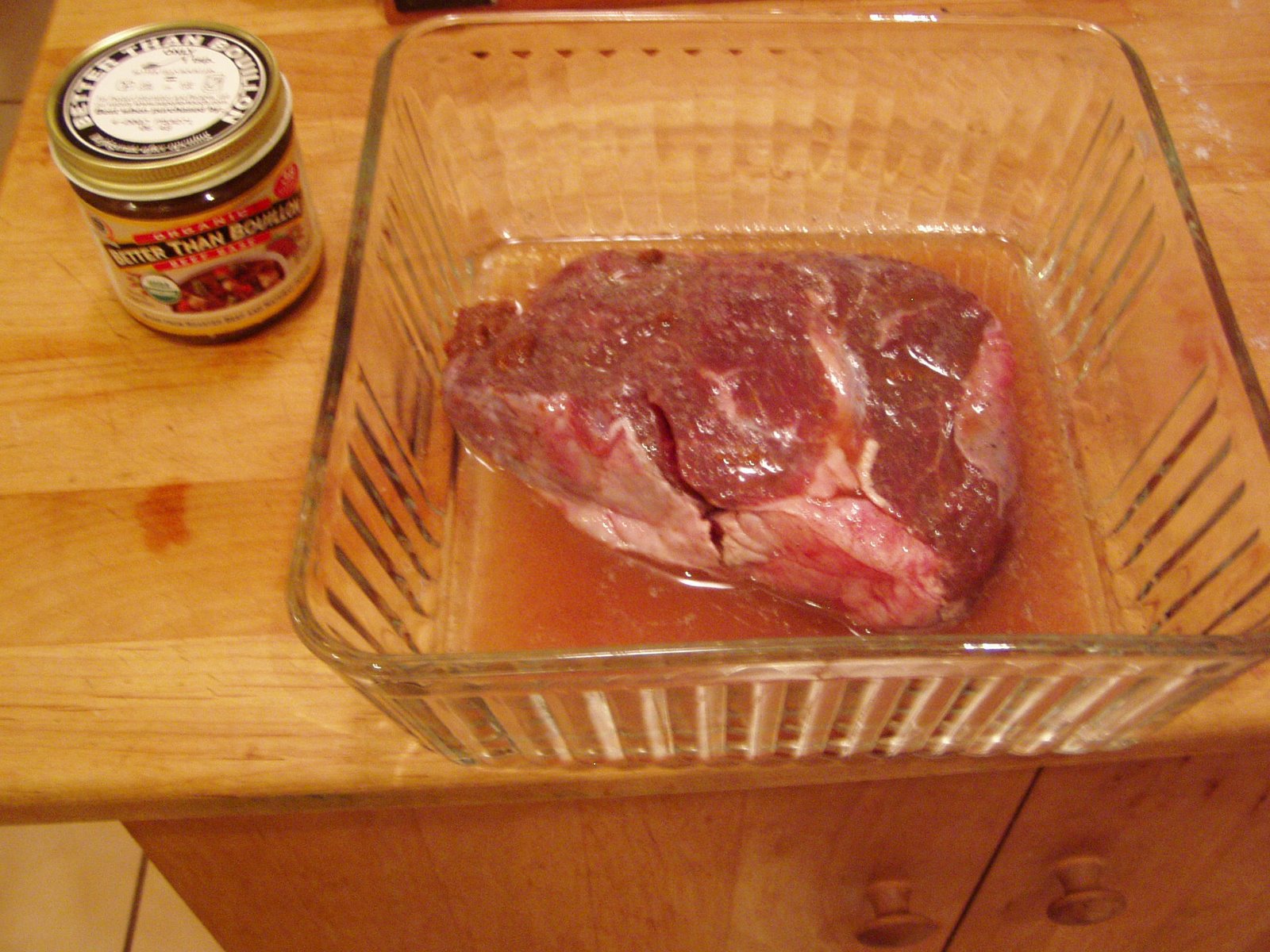
Marinade a 12 oz. buffalo steak in 1/4 tsp. organic Better Than Bouillon Beef Base Bouillon whisked with 1/4 c red wine vinegar and salt and pepper to taste. (My Italian friend Claudia believes that beef bouillon and vinegar mellows gamey meat, and I always follow the instructions of Italians when it comes to food.)

Make a lot of other blue food and let steak sit out entire time in marinade. Pray buffalo is not a good source of E. coli.

Heat up iron skillet for several minutes. Add about 1 tbsp. olive oil. Sear steak on both sides to taste (for me, 3 minutes on each side). Cut steak into thin, bite-size strips for salad.

If food poisoning fears emerge at the sight of bleeding, oozing flesh, toss pieces back in the skillet. Don’t overcook as buffalo can get tough very easily.

Pour 1 container washed mixed baby greens into bowl, remembering after California Spinach Disaster that greens can harbor E. coli as well as buffalo but not caring. Baste with the following, whisked together:

1/4 c olive oil
2 tbsp. balsamic vinegar
Salt and pepper to taste

Add sliced mushrooms. Add bleu cheese. Add steak. Toss. Eat.