Wilted Lettuce Update

The more I seek to uncover the mysterious origins of wilted lettuce salad, the further they disappear into the murky depths of culinary history. Over the weekend, I found a reference to the dish on Thyme for Cooking, a very nice blog with some lovely recipes. Sadly, I’ve mislaid the direct link to the post itself. But the upshot was that Katie, the blog’s author, had included the dish in a list of recipes that she characterized as typical of Midwestern church cookbooks.

“Midwestern!?” I thought. “That can’t be!” I mean, when I see bacon fat and vegetables nestled together in a pot, I assume we have Southern cooking on our hands–a mishmash of African and English food that somehow migrated from black cooks to the poor whites who lived nearby.

So I wrote to Katie to see if she could shed some light on things. Did she know when the wilted lettuce salad recipe first appeared in the church cookbooks she was describing? Would she have any clue about the dish’s origins?

Katie wrote back quickly and said she’s posed my question to her mother. According to Katie’s mom, wilted lettuce salad is an ‘old German’ recipe and is a “standard,” traditional among the older people in her home state of Wisconsin and especially the first generation immigrants.

I was in shock. My ten years in Madison, where those immigrants did not typically live, did not prepare me for this. And yet, it might make sense. Growing up, I’d always heard from my grandfather that one of my Appalachian ancestors had come from Germany–so perhaps this “Southern” dish came from there. But I still don’t know.

And there’s another twist: James Beard’s American Cookery, which I should have checked in the first place, calls wilted lettuce salad “the oldest and probably most functional of salads” (p. 39). And he offers an Italian version made with dandelion greens.

The plot thickens.
So much for planning . . . .

The Return of the Fred has put a crimp in my “cooking school” plans, as we prepare to move the remainder from our worldly goods from the ATL to the RTP. However, in the midst of our turmoil I did come across one of the most, um, interesting recipes I’ve seen in a long time.

The recipe is called “Egg and Coffee Combo” and it comes from a family cookbook that a friend sent me recently. It was submitted by “Uncle Furman”:

Egg and Coffee Combo

1 cup
Pot
1 egg
Instant coffee
Water
Hot stove

Put desired amount of instant coffee in a cup. Fill the pot 3/4 with water. Put pot on hot stove with an egg it it and let water boil for several minutes or more, depending on how you want your egg. Remove the pot. Take out egg. Pour hot water in pot into coffee cup. Stir. Run cold water over egg and strike tenderly and gently with prongs of fork, and disrobe it. You are ready.

I’ve grown to like Uncle Furman. Although he seems thrifty (not typically a quality I appreciate), he indulges in some linguistic extravagances that are quite appealing. I love the image of tenderly and gently disrobing an egg. And I suspect the reference to the “pot” in the list of ingredients is a deliberate double entendre. Maybe that’s the special ingredient that allows Uncle Furman to forget exactly where his egg had been before it went to the store and ended up in the water he used for his coffee.

It’s 1974. Do You Know Where Your Children Are?

Today I reach back into time, as I don’t want to think about today, what with work being a huge headache I want to go away.

So, because a reader with vegetarian children wanted some good cookbook suggestions, I’m going to hearken back to a kinder, gentler period in my life when I did not eat animals. It lasted about six months. It ended when one day, driving past a Krystal and catching a whiff of the fatty oniony odor, I realized I couldn’t live a life where I never had another Krystal again. (See “I have no discipline whatsoever,” below.)

Unfortunately in looking over my cookbook collection I realized that my vegetarian cookbooks are sadly outdated. My favorites, The Vegetarian Epicure and The Vegetarian Epicure Book Two, by Anna Thomas, have been updated by a new edition, The New Vegetarian Epicure, with sleek photography rather than the homey hippie drawings on the older version.

I suspect that the following sentences from the 1974 version–describing a “two hours later course” you can offer guests who linger after a meal–have also been deleted:

“This two-hours later course is especially recommended if grass is smoked socially at your house. If you have passed a joint around before dinner to sharpen gustatory perceptions, you most likely will pass another one after dinner, and everyone knows what that will do–the blind munchies can strike at any time.”

On second thought, maybe you shouldn’t show this to the vegetarian kids. Try some tofu.

Still No Cooking, But . . . .

. . . . I did receive some interesting recipes from Martha Jones in Elberton, Georgia. Martha is a member of the church where Fred preached a couple of times over the last few months. She’s a retired home economics teacher and has written a cookbook, “Martha’s Favorite Recipes.”

The recipe that most interests me? Prune Cake. Prunes are unfairly maligned, too long associated with elderly relatives with digestive difficulties. If you don’t believe me, check out the very brief Wikipedia entry on prunes, which mentions the recent campaign to rebrand them “dried plums.”

So in keeping with the wishes of the Prune Council, or Dried Plum Council, or whoever wants us to think of prunes properly as the delicious, rich, tasty things they are, here is Martha’s recipe:

Prune Cake

1 c. cooking oil
1 1/2 c. sugar
2 eggs, beaten
1 c. buttermilk
2 c. flour
1 c. chopped nuts (pecans or walnuts)
1 tsp. soda
1 tsp. cinnamon
1 tsp. all spice
1/2 tsp. salt
1 c. chopped prunes

Mix oil, sugar and beaten eggs. Sift flour, soda, cinnamon, all spice, and salt. Add alternately with buttermilk, mixing well after each addition. Stir in prunes and nuts. Mix and pour into a greased and floured 9 x 13″ pan (pan may be greased with Bakers Blend Cooking Spray). Bake in preheated 350-degree oven for 45 minutes. Remove from oven, cool, and pour topping over cake.

Topping:

1/4 c. margarine
1/4 tsp. soda
1/2 c. brown sugar
1/4 c. buttermilk
1 tsp. vanilla

Place ingredients in saucepan. Mix and let mixture come to a boil. Pour over cooled cake.

Gifts

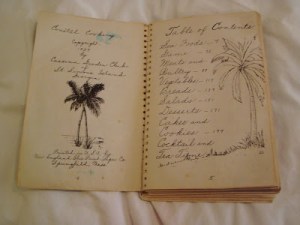
Last night Fred and I went out to dinner with friends. At the end of the dinner, one of them pulled a bag out from under the table and said, “Jami, I wanted to give you this because I thought you would appreciate it. ” Here’s what she handed me:

This cookbook, called “Coastal Cookery,” belonged to my friend’s grandmother. It’s a collection of old, handwritten recipes from the Georgia islands–St. Simons, Sea Island, Jekyll, and Sapeloe. It was first published in 1937. I have to do a little digging to find out more. It doesn’t appear to be a very common book, probably familiar mostly to the coastal residents of the area.

What’s special about this particular book are the notes from my friend’s grandmother. According to my friend, her grandmother had an eighth-grade education but possessed unusual skills in planning and preparing food, from family meals to large formal dinner parties. And she had to, since her husband was a state senator for many years.

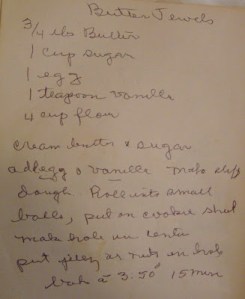
Here is one of the grandmother’s cookie recipes, written on the blank page facing the book’s Table of Contents.

My friend tells me that this was one of her favorite recipes growing up, so the grandmother must have made it many times. But the writing here is that of an elderly woman, slightly crooked, very painstaking. What compelled her, I wonder, to write it down at that moment? Did she want to make sure it was preserved? Did she want to make sure someone else would make those cookies for children and grandchildren?

This may be one of the best gifts I’ve ever received. I’m going to make sure those cookies get made again, and soon.