We’re Famous!

Or at least linked, and to a blog by someone who doesn’t even know us. 30threads, a new site from Ginny from the Blog, included The Newlyfeds in their latest report on Durham’s food blogs. Food Network, here we come.

I was also pleased to discover that 30threads also offers endless potential for procrastination, with links to 30 of the most interesting threads in local blogs. I killed half an hour in between writing these two paragraphs–imagine the possibilities when you’re really trying to accomplish something.
***************
But back to food. On Tuesday we received our CSA (community-sponsored agriculture) delivery, and it allayed some fears that I’d been developing about our choice of a farm. Well, actually “choice” is too strong a word. I waited until the last minute (see note on procrastination, above) and so had to go with the only farm that still had space. Except that it didn’t actually have space–something we discovered after we mailed our check, and e-mailed, and heard nothing, and called, and heard nothing, and called, and were finally told that they never got our check and that there was no space anyway.

In late June, however, we got a somewhat garbled message from the farmer offering us a share for the remaining half of the season because someone had dropped out. Driven by a desperate need for vegetables instilled by our new weight watching habits, we acted like a high school wallflower who’s just been asked to the prom by the star quarterback. We couldn’t return the call fast enough, and my mid-June we got our first delivery.

After four deliveries, I am beginning to understand why our farm, Snow Creek Organics, did not bother to call us back. They’re too busy farming. Here’s what was in this week’s delivery:

The items we recognized immediately were Swiss chard (in the back), tomatoes, red and green bell peppers, and okra. The green items on the left that resemble miniature watermelons are squash (I’m afraid I didn’t get the variety) and the yellow items atop the red pepper are lemon cucumbers. The flowers weren’t part of the delivery; they’re the ones Fred always buys for me at the Duke Mobile Farmers Market, our pick-up site (for the vegetables, that is).

I love that Snow Creek gives us oddball varieties to try. The lemon cucumbers were a delight, with a fresh, clean cucumber taste–although with no hint of lemon. The seeds were large but would be easy to remove using the same process as that for cantaloupe. And the slices would look beautiful in a salad with tomatoes. Unfortunately, we ate them so quickly we didn’t have a chance to find out.

We also made a great discovery about the chard stems. I’d thought they weren’t usable, but my 1946 edition of The Joy of Cooking claimed that you could cook them like asparagus. After tasting one raw, I was skeptical: It was awful–bitter, with no redeeming qualities I could identify.

All the more reason to put Irma Rombauer to the test. And it appears that she, like my mother, is always right. Once cooked, the stems lost their bitterness. They don’t taste the least bit like asparagus, but roasting them with garlic, oil, onions, balsamic vinegar, and salt made for a delicious dish.
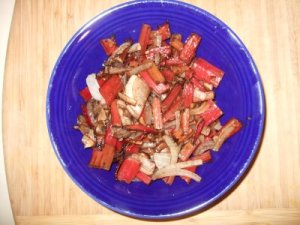
Roasted Onion and Swiss Chard Stems (serves 2)

Preheat oven to 350. Remove leaves from 10 -12 stems of Swiss chard. (Leaves can be cooked like spinach or other greens.) Cut off about 1/4 inch from the bottom and cut chard into 1″ pieces. Quarter a large onion, lengthwise, then slice. Mince 3-4 large cloves of garlic. Toss all ingredients in a large bowl with 1 tbsp. olive oil, several generous splashes of balsamic vinegar (roughly 1/4 – 1/2 cup) and salt to taste. Spread on jelly roll pan or cookie sheet and bake for 20 -30 minutes.
Squashing Weight Watchers!

Truly, repentence has its reward. Our vacation sins resulted in a total weight loss–LOSS, I tell you!–of .2 pounds. Even better, it was all mine. Fred stayed the same. O shrimp and grits, and wine, and beer, and porterhouse steak, and tiramisu cheesecake, where are thy stings?

It’s possible that our return to virtue over the weekend, like sailors back from shore leave, saved us in the end. At Rosemont Farms just outside Kiawah on John’s Island–home of the beautiful chickens and tomatoes pictured in Saturday’s post–we picked up some yellow/summer/crookneck squash in anticipation of renewed discipline upon our return. Of course, it’s a little disingenuous of me to say that, since squash is hardly what I’d call a sacrifice. It’s not up there with tomatoes or peaches in terms of favorite summer produce, but I like it so much that I have to resist the temptation not to serve it several times a week while it’s in season.

The beauty of yellow squash is that it goes well with so many other things and is easy to fix. You can steam it for a few minutes and serve with a little salt and butter, or saute with onions and garlic in olive oil, or instantly increase your vegetable consumption by adding it to zillions of pasta dishes or your favorite burrito.

On Sunday, though, I decided to get out of my squashy comfort zone by cooking it with some of the jalapeno peppers we also picked up at Rosemont’s. Typically when I include jalapenos in a dish, I feel the urge to Mexicanize it by adding cumin, cilantro, and lime. But it seemed terribly wrong to overwhelm the fresh squash with all those spices. So I kept the ingredients to a minimum, served over orzo pasta, and even went so far as to add fresh mozzarella at the end.

The result was a cheesy and flavorful combination, which nicely balanced the hot spike of the jalapenos, the delicacy of the squash and the cool creaminess of the mozzarella.

[Lovely picture of squash dish to follow when Blogger fixes its uploading problem.]

(And the two servings Fred and I had for supper were only 5 points each.)

Orzo with Squash and Jalapenos

4 medium-sized servings (~5 points each), or 2 large meal-sized servings (~10 points each)

1 tbsp. olive oil
1/4 – 1/2 c. chicken stock (or low-salt broth)
1 large onion, quartered then thinly sliced
6 small yellow (summer) squash, halved lengthwise and thinly sliced
2 medium jalapeno peppers (more or less to taste), diced
Salt to taste
2 oz. (roughly 1/2 cup) fresh mozzarella cheese, cut into 1/8″ pieces
1/2 lb. orzo (or other small pasta)

In large skillet, saute onions in olive oil over medium high heat until translucent. Add squash, jalapenos, salt, and 1/4 cup of chicken stock. Cook over medium high heat until squash is tender, 10 – 20 minutes. Add more chicken stock, if needed, to keep vegetables from sticking. (For very soft squash, cover vegetables for part of the cooking time, then remove lid for the last few minutes to boil off some of the liquid.) While vegetables are sauteeing, put water for pasta on to boil and cook according to package directions. Drain pasta. Remove skillet from heat. Add cooked pasta and stir, then add cheese and stir until melted. Serve and enjoy.

Chicken from Heaven

Our wingless friend–the chicken from Rainbow Meadow Farms from last Sunday’s cooking extravaganza–was a testament to the local food movement. It tasted . . . like chicken. Like the hens my grandparents raised, almost as if you’d infused the chicken with a rich broth, or red wine, or even a little tiny hint of bacon. It tasted like real food.

For the purposes of our weight watching, it also offered a revelation. I served it in a variation of an orzo pasta dish from February 2007. That particular recipe included the ingredient “lots and lots of olive oil” and cheese. So when I went to prepare the dish in the weight watching version, I was grumpy. The orzo will be dry, I thought. And tasteless. And who wants to have a life with less olive oil in it?

But when we ate the dish, with only two teaspoons of olive oil and no cheese, we were stunned. Because the chicken actually tasted like something–and, admittedly, had been roasted with the skin on and basted in butter, as I always do–the whole dish was rich and flavorful. In fact, I would go so far as to say that the extra olive oil and cheese would have overpowered the flavor of the chicken.

I’ve long believed that much restaurant cooking in America relies on salt, fat and heavy flavors like bacon and cheese to cover up the poor quality of the ingredients. (You especially notice this if you travel to Italy and come back.) I think that our feathery friend drove this point home.

Orzo with Chicken and Squash (serves 2; 8 points each)

1/4 lb. orzo
2 tsp. olive oil
1 large onion, chopped
2 – 3 medium crookneck/yellow/summer squash, chopped
4 cloves garlic, minced
1/2 cup fresh parsley, minced
1/4 cup fresh oregano, minced
1 cup Rainbow Meadow farms or other great chicken, roasted with skin on, skin removed, chopped
1/2 – 1 cup homeade chicken broth

Cook pasta according to package directions. Saute onions in olive oil in large skillet on medium heat until translucent. Add squash and garlic and saute for 5 minutes. Add garlic and stir. Add enough chicken broth to moisten. Cover and cook until vegetables are tender, about 5 – 10 minutes. Add parsley, oregano, and chicken. Uncover and cook for a few minutes more, until chicken is heated through, adding more chicken broth as needed to moisten. Transfer to bowl and stir in with pasta.

In Honor of Weight Watchers, We Present Fish Salad and Roasted Broccoli

Part I: Weight Watching

We’ve given up. We went to Weight Watchers yesterday.

It’s a sad day for the house that loves guanciale, and butter, and pasta, and roasting a chicken just so we can eat the skin. But we really have no choice. I am 7 pounds over what is considered a maximum healthy weight for my height, and Fred–well, he’s a little more than that.

Our mission now will be to create dishes that will keep us within our daily points allowance but won’t completely compromise our food integrity. This means none of the glue-like substances that some marketers try to pass off as food, like fat-free cream cheese and mayonnaise. I don’t think we can take that. But we can certainly eat a heck of a lot more vegetables, and probably much smaller portions of the things we love.

I am also delighted to report that a Bloody Mary is only 3 points, but just 2 if you use only a splash of tomato juice.

Tonight, we cooked the last of the guanciale in a pasta dish. We just ate less of it and more of the broccoli I fixed to go with it. A colleague offered the following preparation for the broccoli, which turned out to be quite good.

Roasted Broccoli

Cut up two heads of broccoli. Toss in 1 1/2 tbsp. olive oil and salt it to within an inch of its life. Roast in a shallow pan at 400 degrees until just beginning to brown, about 10 – 15 minutes.

“It’s just like popcorn,” my co-worker told me, and it’s pretty darn close.

II. And Then There’s the Fish Salad

I have also been meaning to talk about the spectacular fish salad I created last week with some leftover broiled triggerfish. Unfortunately its next iteration will probably have to wait until after the Weight Watchers project is over, or until I have not eaten for several days.

This is a great way to use leftover broiled, poached, or grilled fish. Since you don’t have to re-heat it, you don’t risk the overcooking that usually renders leftover fish dry and nearly inedible.

The recipe would work well with any white fish that you typically cook through rather than serve rare. If you have a leftover piece that is rare (like salmon or tuna), you might want to broil or poach it for a minute or two before making the salad.

Fish Salad (makes about 2 cups)

1 piece cooked fish (about 4 oz.), bones removed if necessary, chopped fine
2 – 3 carrots, peeled and minced
2- 3 stalks celery, minced
1 small sweet onion (Vidalia or other mild variety), minced
1/2 cup peas, cooked until just tender, drained (pour cold water over peas to stop cooking)
1/2 cup mayonnaise, or more to taste
Salt to taste

Mix all ingredients together in bowl. Serve with crackers or with a sandwich. Don’t count the Weight Watchers points.

Guanciale Renders Cook Speechless with Ecstacy

It’s entirely possible that tonight’s dinner was the best I have ever eaten.

It started with the recipe for Pasta alla Gricia from the January New York Times spread on guanciale that I mentioned in yesterday’s post. Pasta alla Gricia is arguably an ancient dish, made before the Italians had tomatoes (but obviously after they got hold of pasta from the Chinese). It consists of simply guanciale (now my favorite meat), onions, pasta, and cheese.

But I had other issues to consider in preparing this dish. First, I had this squash from our Farmer’s Market expedition over the weekend.

Second, I was too lazy to cook it separately.

So I started by frying the guanciale, for once being a good citizen and following the recipe.

I remained virtuous and added the onions.

And then I stared at the squash for a long time. I could get out another pan, I thought. I could cut up another onion, a little garlic, add some olive oil, saute it all for a side dish. I could for once in my life maintain the purity of the original recipe and not add something else at the last minute just to see how it turned out.

Or, I could just dump that squash right in. As is usual with me, Virtue lost. Undisciplined Possibility triumphed.

Thank God for Undisciplined Possibility.

I felt I showed admirable self-restraint by not licking the bowl.

Pasta alla Gricia with Squash (serves two greedy people)

1/2 lb penne
1 cup water from boiled pasta
1/3 lb guanciale (4 – 6 slices), sliced into 1″ long x 1/4′ wide strips
1 medium sweet onion, halved and sliced thin
4 small summer (crookneck or yellow) squash, cut in half lengthwise and sliced thin
Salt
Fresh ground pepper
2/3 cup aged pecorina cheese, divided in half (or more to taste)

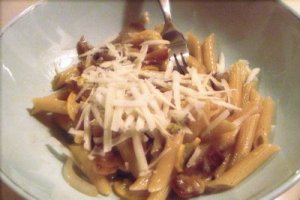
Put water for pasta on to boil. Fry guanciale on medium high heat in large skillet. When guanciale is beginning to brown, add onions and cook until translucent, stirring often. (Do not drain fat.) Reduce heat to medium and add squash; cook until squash is tender, stirring often. Cook pasta in boiling water until al dente. Drain over bowl to catch water. Add pasta to skillet. Add salt to taste and generous amounts of pepper. Add 1/3 cup cheese and 1/2 cup pasta water and cook over medium heat until cheese begins to melt. Add enough additional pasta water to melt cheese and coat pasta, stirring continuously. Serve with remaining cheese.

Truffle Oil

In a recent post, Hulga asked what to do with truffle oil. I have a few quick and easy suggestions.

This one is from a friend.

Salad with Truffle Oil and Parmesan: Drizzle truffle oil over greens. Add a splash of balsamic vinegar and salt to taste. Toss greens. Top with freshly grated Parmesan cheese. For variety, add fresh mushroom to greens before tossing. The daikon radish, sliced or grated, would make a nice addition as well.

You can also drizzle truffle oil over boiled potatoes or freshly sliced daikon radish (as I did a couple of days ago). Another good use is in pureed, starch-based soups like potato, celeraic, white asparagus, or cauliflower. I have also heard of recipes for turkey dressing that use it, but I haven’t tried that myself.

Truffle oil has a strong flavor, so you will want to use it sparingly and pair it with foods that won’t compete with it.

Hope this helps with your truffle dilemma!

Me vs. the Daikon Radish

Tonight, I faced down the daikon radishes that defeated me in Saturday’s dinner. This time, I used simpler, more reliable weapons, weapons that a cook of longer experience would have deployed much sooner.


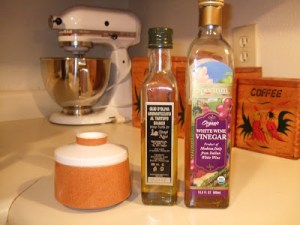
The first round of artillery came from the bottle in the middle: a little truffe oil, drizzled over the top of the thinly sliced radishes, with salt. I did not end up serving this at our meal; it seemed too rich to serve with the Mae Farm pork left over from Saturday.

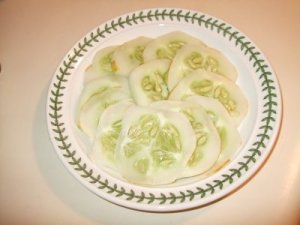
Instead, the most humble implements proved the most effective: white vinegar and sugar. (The sugar bowl pictured here, by the way, belonged to my grandmother, who would have been proud to have taken up arms in this battle.) Cucumbers and tomatoes marinated in vinegar and sugar represent and ancient and proud tradition; daikon radishes are pickled in Japan; it all works.

All you do is this: Peel the daikon radish and slice thin. Salt generously. Mix about 1/4 to 1/3 cup white wine vinegar with roughly equal parts sugar. Stir vinegar mix repeatedly until sugar dissolves. Pour over sliced radish; marinate for an hour if possible. Add freshly ground black pepper to taste.

Relish your victory.

How to ruin a vegetable

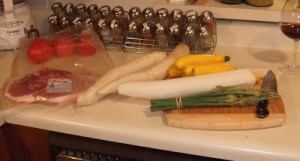
Our Saturday supper started off with promise. We made a trip to the Raleigh Farmer’s market and picked up a bounty of fresh produce and pork raised on a small, local farm:

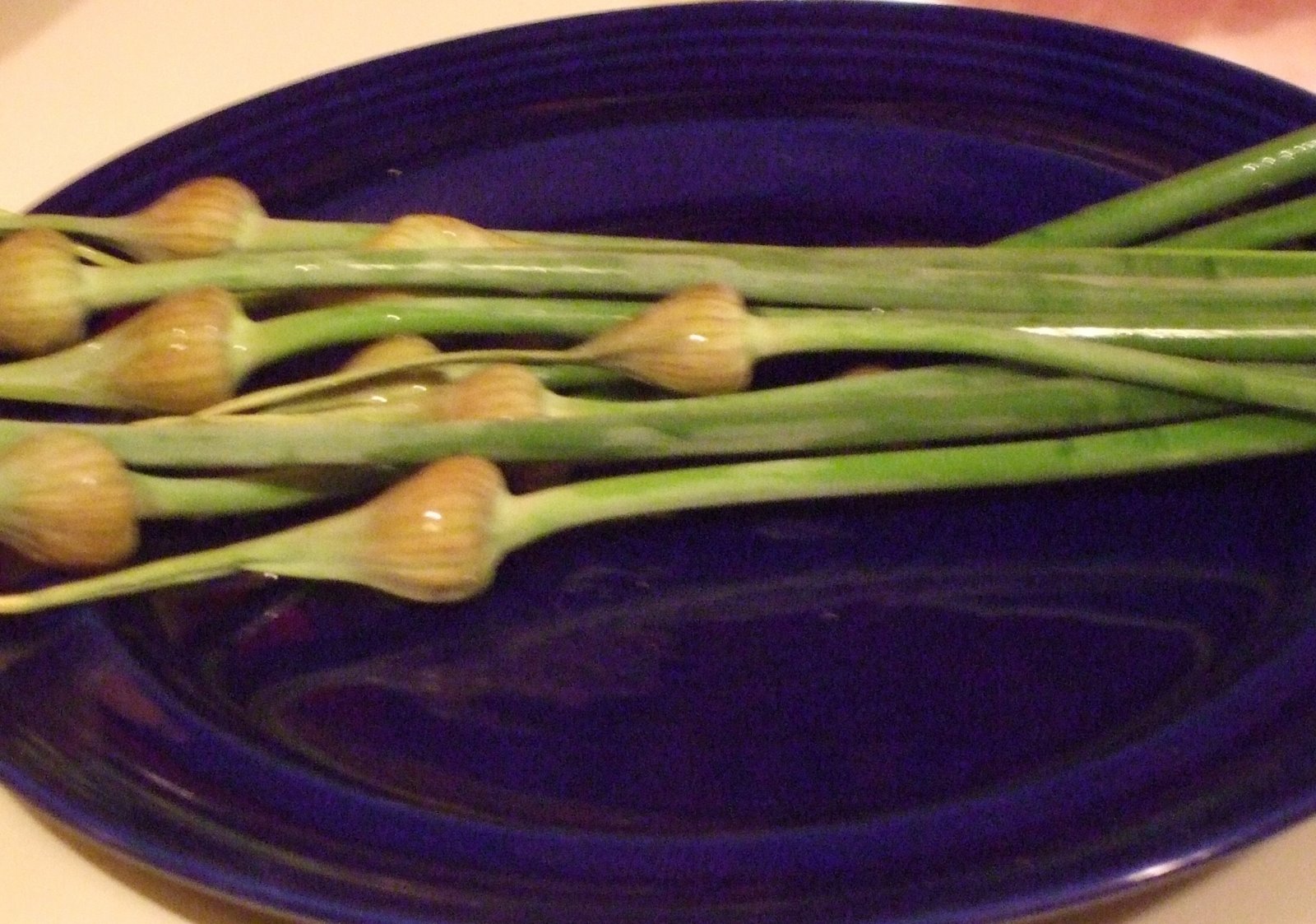
Pork, tomatoes, Daikon radish, zucchini, and elephant garlic sprouts

The garlic sprouts looked beautiful.


As did the spring onions.


“What could possibly go wrong?” you ask. Well, I committed the cardinal sin of cooking fresh vegetables: I got fancy. I sauteed the daikon radish in chicken broth, added some of the garlic sprouts, cream, and a few other things I can’t remember. It was a mess of flavors, the culinary equivalent of puce, the tastes competing with rather than complementing each other. A similar disaster occurred with the zucchini.

It was another reminder of the most important rule to follow when you have fresh, seasonal vegetables: Steam them, add some olive oil or butter and salt, and leave them alone.

But then there was the pork. What a spectacular pig it must have been. It came from Mae Farm Meats in Louisburg, NC, whose web site shows happy, fat pigs lounging in the sun. A happy pig is a tasty pig. The ham steak we purchased was surrounded by a beautiful layer of flavorful fat, and it was arguably the best pork I’ve ever had. I can’t wait to try the bacon–and I cannot resist adding that it was $2 per pound less than Whole Foods.

The F Word

Fat, that is.

Last week I went in for my annual physical and the scale revealed terrible, terrible news: I weigh the most I ever have in my life. Not much more, but that’s not the point. Apparently the desserts, the bacon fat, the butter, the steaks, the pasta, and the wine (the last purchased and consumed to cope with the outrageous food prices here in the RTP) have taken their toll.

And so, Fred and I have embarked on a . . . an effort to improve our eating habits and get in better shape as middle age attempts to settle itself around our waistlines. To that end, we bought shares in an organic CSA (Community Sponsored Agriculture). The farm will deliver a box of fresh, organically grown vegetables to us each week at a mere $18 a pop–about the same amount as a small bag of lettuce at Whole Foods.

I made some particularly tasty dishes on our maiden voyage into the die–um, more vegetable-oriented food waters. One surprising effort was this soup:

Tomato, Cauliflower, and Ground Beef Soup

Serves 2 with leftovers

1/2 lb. ground beef (for vegetarians, omit beef and saute vegetables in 4 tbsp. butter)
1 medium onion, chopped
4 cloves garlic, minced
2-3 stalks celery, chopped
1 head cauliflower, cut into very small stalks about 1″ in size, or chopped
1 16-oz. can crushed tomatoes (I had home-canned, but Muir Glen or another good brand would do)
2 c. chicken broth (if using canned, use low salt)
Salt and pepper to taste
1 – 2 tsp. crushed red pepper
2 tsp. thyme

Brown beef on medium high heat in medium to large soup pot. Drain all but 1 tbsp. fat, or leave fat in if you are not di–increasing vegetable consumption. Add onion and saute on medium high heat until translucent. Add garlic and stir. Reduce heat to medium; add celery and saute about 10 minutes. Add remaining ingredients. Cover and cook on medium heat until cauliflower is tender, about 45 minutes.

Pasta Primavera, and My Life

I work all the time. And so I have time to cook but not to write about it–except for the article I wrote for the April Oakhurst Leaflet. The advance copy is published below for your reading pleasure.

I never understood why T.S. Eliot said that April was the cruellest month until I lived in the Midwest. Expecting the warm spring temperatures of my native South, I was stunned when the end of the month found me in sweaters and the same awful boots I’d been forced to wear almost daily since October.

But luckily we don’t live in the Midwest. We live in a beautiful,warm, sunny climate, where peas and carrots and other delicious things are growing themselves for our tables. There’s no better way to celebrate than to throw these vegetables that are happily sunning themselves in the garden, or snuggling together in the bins at the grocery store as they enjoy the occasional water spritz, into a nice pasta primavera.

Pasta primavera means simply “spring pasta” in Italian. There are zillions of recipes for this dish, but a recipe to my mind destroys the stunning, simple, brilliant concept: Take vegetables you like, cook them a little, and serve them over pasta with oil or in a cream sauce. You can also make it as heavy or light as you like, depending on your current feelings about appearing in public without a sweater.

Instead of a recipe, then, I offer these pasta primavera guidelines.

Ingredients

1 lb. sturdy, thick pasta: (farfalle, penne, rigatoni, spaghetti, linguini, or fettuccine. I don’t suggest cappellini (angel hair) because it easily overcooks.
1 – 2 large onions (chopped) and 2 – 4 cloves garlic (minced).
Butter or olive oil for sauteeing
3 – 4 cups vegetables: carrots, celery, peas, zucchini, broccoli, mushrooms, asparagus, and peppers are excellent choices. Cherry or grape tomatoes are nice too, but don’t cook them–add at the end. Cut the vegetables to suit the texture of the pasta: sliced or chopped for short pastas, julienned or finely chopped for long.
Salt and pepper
Basil, thyme or oregano. If fresh, use 6 – 8 stems of each; if dried, 1 – 2 tsp.
Up to 1 cup grated Parmesan cheese
Up to 1 cup cream or half and half (optional)

Preparation

Cut vegetables and grate cheese. Put salted water on to boil and cook pasta as you prepare ingredients. Saute onions in butter or oil on medium heat in large skillet. Add garlic and stir. Add vegetables and stir. Add herbs. Cover and cook until just tender. Add cooked pasta. Garnish with cheese.

Swimsuit version: Use olive oil to saute. Add herbs to onion and garlic after sauteeing. Steam vegetables. Pour over cooked pasta; add cheese and olive oil to taste.

Shorts version: Use butter to saute. After vegetables have cooked, add up to ½ cup half and half. Cook on medium heat, uncovered, for 3-5 minutes, until sauce has thickened. Add additional half and half or butter to coat pasta, if needed. Garnish with Parmesan.

Sweater version: After vegetables have cooked, add 1 cup heavy cream and cook on medium heat, uncovered, 3-5 minutes. Reduce heat to low and gradually add 1 cup Parmesan; stir until melted. Garnish with additional Parmesan.