Happy Bloomsday

Which also happens to be my 43rd birthday today.

To celebrate the occasion, my beloved husband made fried chicken, baked potatoes, gravy, and a salad. The man can fry. He used his grandmother’s cast-iron Dutch oven, every drop of oil in the house, and an organic chicken he cut up his own self, without noticeable injury. He soaks the chicken in butter and insists on removing the skin, which I normally would consider sacrilige. But he may have won me over.

I had been worried about the gravy based on the following conversation:

Me: “Fried chicken would make a wonderful birthday dinner! I’d just like to request gravy to go along with it. I can make it if you need me to.”

Fred: “Oh, that wouldn’t be too hard. You just add milk to the grease in the skillet, right?”

I am stunned into speechlessness.

“Honey?”

Words return. “No, that just would give you warm, greasy milk. There’s one thing you left out.”

“What?”

“Flour.”

“Really?”

Luckily, Fred consulted Mrs. S. R. Dull’s Southern Cooking before going further. He apparently added a splash of red wine to her recipe, which is not an inventive touch I normally would condone, but I was blissfully out of the kitchen.

Mrs. Dull’s recipe tells you to spoon the chicken grease into a pan and add butter. Add your two tablespoons or so of flour, then a cup of milk and a cup of water, and salt and pepper. I would have used all milk and no butter, and certainly no red wine, but this was still a nice, rich gravy, browner than what my grandmother made. And it was good.

It was a wonderful birthday.

How to ruin a vegetable

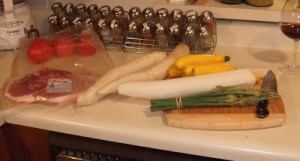
Our Saturday supper started off with promise. We made a trip to the Raleigh Farmer’s market and picked up a bounty of fresh produce and pork raised on a small, local farm:

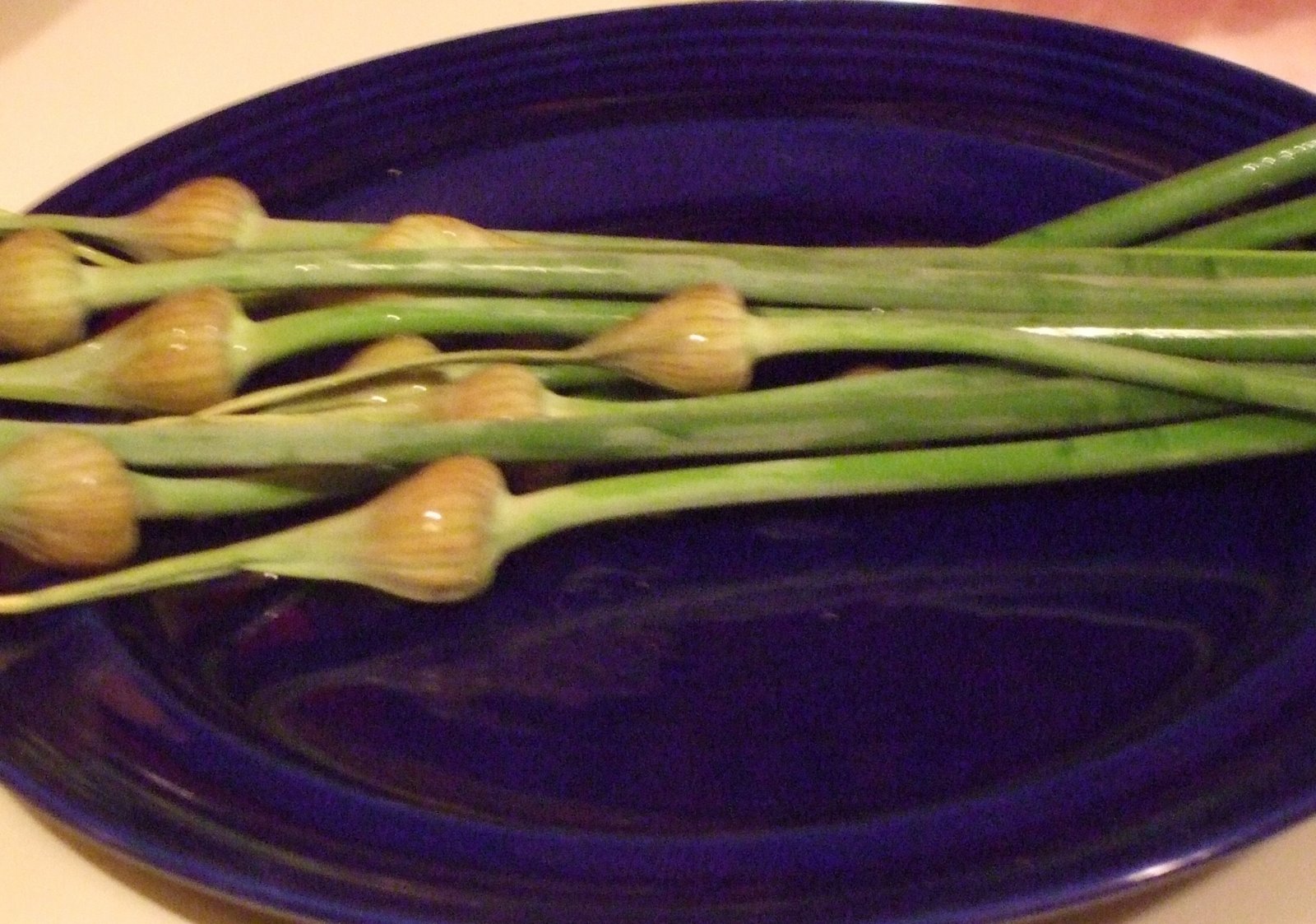
Pork, tomatoes, Daikon radish, zucchini, and elephant garlic sprouts

The garlic sprouts looked beautiful.


As did the spring onions.


“What could possibly go wrong?” you ask. Well, I committed the cardinal sin of cooking fresh vegetables: I got fancy. I sauteed the daikon radish in chicken broth, added some of the garlic sprouts, cream, and a few other things I can’t remember. It was a mess of flavors, the culinary equivalent of puce, the tastes competing with rather than complementing each other. A similar disaster occurred with the zucchini.

It was another reminder of the most important rule to follow when you have fresh, seasonal vegetables: Steam them, add some olive oil or butter and salt, and leave them alone.

But then there was the pork. What a spectacular pig it must have been. It came from Mae Farm Meats in Louisburg, NC, whose web site shows happy, fat pigs lounging in the sun. A happy pig is a tasty pig. The ham steak we purchased was surrounded by a beautiful layer of flavorful fat, and it was arguably the best pork I’ve ever had. I can’t wait to try the bacon–and I cannot resist adding that it was $2 per pound less than Whole Foods.

The F Word

Fat, that is.

Last week I went in for my annual physical and the scale revealed terrible, terrible news: I weigh the most I ever have in my life. Not much more, but that’s not the point. Apparently the desserts, the bacon fat, the butter, the steaks, the pasta, and the wine (the last purchased and consumed to cope with the outrageous food prices here in the RTP) have taken their toll.

And so, Fred and I have embarked on a . . . an effort to improve our eating habits and get in better shape as middle age attempts to settle itself around our waistlines. To that end, we bought shares in an organic CSA (Community Sponsored Agriculture). The farm will deliver a box of fresh, organically grown vegetables to us each week at a mere $18 a pop–about the same amount as a small bag of lettuce at Whole Foods.

I made some particularly tasty dishes on our maiden voyage into the die–um, more vegetable-oriented food waters. One surprising effort was this soup:

Tomato, Cauliflower, and Ground Beef Soup

Serves 2 with leftovers

1/2 lb. ground beef (for vegetarians, omit beef and saute vegetables in 4 tbsp. butter)
1 medium onion, chopped
4 cloves garlic, minced
2-3 stalks celery, chopped
1 head cauliflower, cut into very small stalks about 1″ in size, or chopped
1 16-oz. can crushed tomatoes (I had home-canned, but Muir Glen or another good brand would do)
2 c. chicken broth (if using canned, use low salt)
Salt and pepper to taste
1 – 2 tsp. crushed red pepper
2 tsp. thyme

Brown beef on medium high heat in medium to large soup pot. Drain all but 1 tbsp. fat, or leave fat in if you are not di–increasing vegetable consumption. Add onion and saute on medium high heat until translucent. Add garlic and stir. Reduce heat to medium; add celery and saute about 10 minutes. Add remaining ingredients. Cover and cook on medium heat until cauliflower is tender, about 45 minutes.

Fred . . . Can . . . Cook!

I rescind every smarmy comment I made about Fred’s tendencies to sear plastic to the top of the stove and live on corned beef and cheese. Last night, in a display of deep devotion–and probably a desire to avoid certain destruction because I was very irritated that I have to work ALL THE TIME–he made a lovely and perfect supper. Drawing on the best techniques of his bachelor days, he baked a perfect, flaky, tender potato; assembled a salad topped with perfectly boiled eggs; and garnished the whole thing with cheese and sliced apples. And as I sat working on a grant proposal, wondering why I was working past 6 p.m. instead of cooking, he also brought me a plate of sliced cheese, crackers, and sliced apple–lovingly presented, perfect complements to each other.

Tonight he is making French fries and hamburgers, as I get to indulge in a tiny bit of writing. It is wonderful to be loved so much.

Hack, hack

No, that is not the sound of my chopping onions with a dull knife. Nor is it a sign that I’m taking up a new form of writing. Instead, it’s the sound that’s permeating the Wise household as I type this.

Fred has been laid up with the flu and I’ve had bronchitis. We hope to return to cooking school again soon!

Back to School with Husband

I promise to return to cooking school this week, but it was an unexpectedly joyful and momentous weekend in the Wise household. Fred is here to stay! His return happened a bit more quickly than I’d dared to hope, so suffice it to say we’re thrilled to be back together.

Of course, Fred’s arrival necessitated a festive meal involving some form of animal flesh, and I used the opportunity to implement Lesson 1 on mis-en-place. As Fred writes in his blog entry, I purchased his favorites: cheese, steak, and peanuts. We won’t quibble very much over his failure to list the maple pecan pie I made him from scratch, with a wonderful butter crust that actually managed to be flaky, but I am sure that our friends who will receive all the remaining pieces will be appreciative.

The ingredients from the meal came from Trader Joe’s in Chapel Hill, and the visit marked my first excursion to a Trader Joe’s. The store does not have the feel of luxury and glamour I get from other stores that offer $8 per pound bacon, but then again, I didn’t spend my Whole Paycheck there either. (In all fairness, I did see uncured bacon there that was actually more than $8 per pound, but the $6 bottle of actually drinkable cabernet sauvignon made up for it.)

But that’s really the subject of another entry. Trying to implement Lesson 1, I tucked my towel in my apron, as the professional chefs who commented last time recommended. I discovered, however, that my kitchen is just too tiny for this to matter. The reality is that the towel that hangs on the oven door and the one on the wall next to the “pantry” are always within easy reach. (I will download a photo to demonstrate as soon as I figure out how to do that with Fred’s new camera.) Other items, such as spoons and spatulas, are so handily located that all I need to do is make sure they’re clean and in place.

What was helpful, though, was thinking through how I was going to prepare and set out the meal, even though it was quite simple: an appetizer of bought olive bruschetta and crackers, two cheeses, and bought honey roasted peanuts; steak; a salad of baby greens with button mushrooms and Irish cheddar cheese; and the maple pecan pie. Typically, my technique is to dive in and beginning preparing one thing that will take a while, somehow hoping that I’ll have time to do everything else as the first item is going. But this time, I set out the ingredients and thought about the entire meal first. Here’s how it went.

Step 1: Make pie crust and refrigerate.
Step 2: While pie crust is chilling, set out appetizers, except cheese, on nice plates. Include spoon for nuts and knife for cutting cheese. Remove cheese from wrapper, set on board and cover with plastic wrap in refrigerator before serving. (The cheese would have been fine set out, except it would have ended up on the floor with suspiciously cat-shaped teeth marks covering the remains.)
Step 3: Salt and pepper steak and drizzle with Worcestshire sauce. (This is Fred’s favorite marinade.)
Step 4: Rinse mushrooms and set on paper towel to dry. Julia Child says you don’t have to rinse them, but I just can’t help it.
Step 5: Make dressing for salad with olive oil, spicy mustard, and balsamic vinegar.
Step 6: Grate cheese and store in refrigerator.
Step 7: Roll out pie crust, set in dish and flute edges, and refrigerate.
Step 8: Preheat oven for pie.
Step 9: Put pie ingredients into shell and bake pie. Take pie out of oven before you leave to pick up husband at the airport so pie will have time to set.
Step 10: Pick up ailing husband, who is suffering from a cold that has depleted his appetite, an hour later than planned. Arrive home at 10:00. Munch on appetizers and cut into pie that has not had time to set but is still good. Leave steak and salad for the next day and go to bed.

My Working Life

A few days ago, while we were on vacation skiing, I was griping about having to go on a business trip after vacation. Yes, we’re hosting a group at The Cloisters on Sea Island, located in one of the richest zip codes in the U.S.; yes, I get to stay in a $1,300 a night room for free; yes, there would be good food. But I had serious doubts that all this would offset missing Fred and having to be extra special nice to lots of people for three days.

But last night, after eating one of the most spectacular pieces of filet mignon I’ve ever had, and having my driver pull up in the Jaguar and shuttle me back to my room–which is as big as our house in Decatur–and curling up on my oceanfront balcony in the robe and slippers the maid had laid out, and speaking with room service about my morning coffee and breakfast delivery, I decided it wasn’t so bad after all. It’ll be really easy to be nice here.

Mis-en-Place for the New Year

Thanks to everyone for your comments and encouragement this year. Happy 2008 to all!

Here at The Not-So-Newly-But-Overly-Well-Feds we have committed ourselves to a new plan for 2008. We will learn how to be a better cook, and we will take you along with us.

“But you already know how to cook,” you say. “Is Fred going to try something besides exploding eggs in your pots and welding Wonder bread packages to the stovetop?”

Yes, I can cook, and no, Fred is not getting anywhere near my kitch . . . I mean, the kitchen if I can help it. But I know squat about the technical side–the part where you measure things, and know maybe half of the terms a professional chef might use, and can explain why you shouldn’t use a cast-iron skillet for a tomato sauce.

My plan was spurred, or inspired, by a post on Michael Ruhlman’s blog by Bob del Grosso. I quote here because the post was part of an excruciatingly long thread, but here’s the link. Explaining why home cooks get inconsistent results, he writes:

“One day the cook leaves a roast out on the countertop for an hour or so before cooking while on another day he pulls it from the fridge and slams it right into to oven. The pre-warmed roast cooked to 125-130, carried over to 140 is evenly rare while the other roast shows a ring of well done on the outside and lens of rare in the middle.

One day he lets the roast rest in front an open window and finds that it only carries over to 130 and on another day he shoves it into a corner and it carries to 150.

Point is that it is not good enough to only focus on the quality of ingredients or the steps that one follows while constructing a recipe. It’s also important to focus on the totality of the cooking (And eating!) environment and to be aware of things like internal and surface temperatures of foods prior to, during and following cooking.

I may be stating the obvious here, and I certainly mean no condescension, but when you take cooking seriously, it gets very very interesting and very very challenging.”

Well, my goal is make my cooking more interesting and challenging this year, and to learn things, and to record it here.

Let’s start with the towel on the shoulder from my last post. I learned (far too recently to tell you when without embarrassment) that’s part of my “mis-en-place,” which is simply the practice of setting out everything you need before you begin preparing a meal. It’s something I’ve known and ignored since childhood. It’s possible the technique was developed by August Escoffier (1846-1935), who pioneered the “brigade” style of French cooking, but I bet my great-great-grandmother was doing the same thing in Appalachia around the same time.

Here is my mother’s advice on mis-en-place. I was going to cite some other sources, but after consulting them I was reminded, once again, that my mother is always right.

First, about your kitchen setup:

You will be a better person and a happier cook if you keep your kitchen organized–not perfect, or even tidy, but organized. That is, put everything back in exactly the same place every time, and make sure most frequently used items are handy. Example: Pots and pans should be within easy reach of the stove, with those you use daily towards the front and those used less often in the back. All those who desire to “help” in the kitchen should have the system explained to them, or they should buy you a label maker for your birthday.

Now, for the actual cooking:

1) If you’re using a recipe, read through the entire recipe first. If not, decide what you’re going to make and what ingredients you’ll use. Check to make sure you have all the ingredients and equipment you need. I only sorta kinda do this, which certainly makes my cooking exciting and interesting, especially when I set out to make, say, an omelette and discover the expiration date on the carton of eggs was two months ago. But things will be different now. Really.

2) Put a towel on your shoulder for cleaning up accidents and make sure you have cleaning items (sponges, paper towels, etc.) close by. (Okay, what the pros say is actually slightly different. In Kitchen Confidential Anthony Bourdain writes that he merely squirreled away his favorite towels at the beginning of every shift. But you get the idea–be prepared to clean up after yourself.)

3) Determine the equipment you need–measuring spoons, skillet, bowls, pots, cups. Set it out. If you’re short on countertop space, you don’t have to pull everything out–just check to make sure it’s clean and exactly where it should be.

4) Prepare as many items as possible before you actually assemble the dish: chop vegetables, grate cheese, measure liquids, etc. Clean up your mess as you go. Place prepared items in bowls or plates and set aside.

5) Pre-heat oven and move racks as needed. Check the recipe again, make sure everything is in place, and get going . . . .

This may sound intimidating, but it’s a heck of a lot better than setting out to make pecan pie on Christmas Day, then spending over an hour looking for an open convenience store that sold flour, only to discover the two bags of pecans you had in the freezer were actually 1) over two years old and 2) walnuts.**

** Okay, I did find a bag of pecans underneath some ancient, frozen wheat germ. . . . see what I mean by “organized”?

Alive, but with Corrections

I survived snowboarding yesterday and even enjoyed it. But my sister is finally enjoying her moment of triumph after I forgot her birthday in October. She noted that I neglected to mention a few ingredients in my Granny’s dressing recipe–namely, onion and celery sauted in butter. The corrected version of the recipe now appears in the original post, which you can find here, along with her comments.

Here’s a photo of me with the dressing, at Christmas a couple of years ago. Note the towel on the shoulder–for my family, this is an essential part of preparing any meal. It’s handy for all those times you accidentally spray yourself with water or otherwise spill things on yourself.


You can vaguely see my sister taking a photo in the mirror in the background. I’m sure she’s cackling at the thought I might have forgotten the celery and onion.

The Great Flour Expedition, and Pecan Pie

Coming home from our day with Fred’s family on Christmas, Fred and I decided to stop at a convenience store on the way back from Covington, GA, to pick up some flour. The goal was to make the pecan pie he loved so much at my mother’s, and which had disappeared all too quickly. Flour was the only ingredient we lacked. We even had Karo syrup, which I hope never goes bad, since this particular bottle has been on my shelf since before I married Fred.

At our first stop, I trotted to the back of the store where a lone bag of flour sat next to several bags of sugar, a few containers of salt, and charcoal. The price was alarmingly absent. Still, I picked it up, but was brought up short when I noticed it was open.

Being the good citizen that I am, I took the open bag up to the counter and set it in front of the clerk, who was probably also the owner. He was an Indian version of Mr. Rogers: kind-eyed, gray-haired, just beginning to go gray, wearing a light blue sweater vest and sensible shoes.

I chirped up in my best good citizen voice, “I was going to buy this, but it was open.”

The owner looked bewildered. “You take?” he asked.

I tried again. “No, I’m sorry, it’s been opened.”

He looked kindly at me, as you might at a mentally deficient child, and nodded. He took up the bag from the counter, carefully folded the top back down, lifted it up, carried it to the back of the store, and returned it to its place on the shelf.

Stunned, I considered spluttering out something about bugs, or crazy people with arsenic, or terrorists with powdery substances that might react mysteriously with an open bag of flour. But realizing the owner would only wonder why the odd lady who brought a perfectly good bag of flour to the counter for no apparent reason was babbling on about bugs and terrorists, I thought better of it and left.

Our quest continued, through two Shell stations (one with no flour at all, the other with only self-rising, which I feared would fluff the pie crust to twice the required size); an Exxon station that stocked only chips and beer; a CVS pharmacy that had sliced pineapple, the ubiquitous sugar, and honey, but didn’t even carry flour at all; and a few other places I can’t remember.

We finally despaired of finding any flour in Covington and got back on I-20 towards the ATL. We took our exit at Candler Road and stopped at the first convenience store we saw. I steeled myself against the hungry eyes of the hollow-cheeked, crazy-haired meth/crack addicts standing outside, one of whom kindly wished me “Merry Christmas” and opened the door, and dashed in.

In a back corner, next to some graham crackers, sugar (of course), and only a few shelves away from the motor oil, I found it: a bag of all-purpose White Lily. Not the ideal pie flour, of course, but better than nothing.

One of the addicts opened the door for me on my way out. “Spare some change?” he chimed hopefully. Not wanting the store owner to shoot me for encouraging these guys to lurk outside his shop, I shook my head and zoomed past him, keeping my head down, as I got into the car.

About a block away, the Piggly Wiggly was open. I like to think they were out of flour.

Naturally, it was two more days before I made the actual pie.

Out of curiosity, I compared my mom’s recipe against Cook’s Illustrated’s so-called “Perfect Pecan Pie” to see how it stacked up. I am getting a little tired of CI’s claims to “perfection,” but I can’t help myself–I am a good citizen, and I like getting the teacher’s approval. In this case, my mom’s recipe has a lot of similarities to CI’s–lower on sugar the typical version, with more pecans, which are chopped and mixed in with the filling rather than floating on top. Your typical Southerner may not appreciate it for those reasons, but it’s what our family loves.

I confess I veered away from my mother’s pie crust recipe, which is basically the same as the one on the back of the Crisco can, and ventured into a butter crust for this pie. This was because our Crisco had gone rancid, and I had to make something up. Fortunately it was spectacular–crispy and buttery, with just enough flake–and so I’ll share that recipe here too.

Pecan Pie

Crust (makes 2 single crust or 1 double crust):

1. Put a coffee cup filled with ice water in the fridge.

2. Stir or whisk together, if your whisk is not in another city:

2 cups plain flour (I had to use coffee cups and guesstimate)
1/2 t salt (again, guesstimated using the palm of my hand)
1 -2 tbsp. sugar (or however much you get when you dip three fingers and your thumb into the sugar bowl and scoop it out)

3. Cut in 12 tbsp. butter, cut into 1/4″ pieces. With no pastry cutter or food processor handy, I used the French method of pinching and rubbing the butter and flour with the ends of my fingers until it resembled cornmeal with some large pea-sized lumps of butter in it. I’m now wondering if I’ve underutilized this technique.

4. Remove ice water from fridge and add to flour mix. This is the trickiest part of a pie crust, and there are multiple techniques. The key is to mix as little as possible. For this crust I used what I call the flip technique, although I have no idea if this is the technical name or not. I sprinkled about 4 tablespoons of water over the flour, then flipped upward through the mix rapidly with a fork until it began to come together. I kept adding water, a couple of tablespoons at a time, until the dough came together in fairly large chunks.

4. Gather dough together and form into a ball. Separate into two separate balls, put in plastic bags, and refrigerate at least an hour before rolling out.

5. Before mixing pie ingredients, roll out crust into a 9″ pie plate. Prick bottom and sides with a fork (or cover bottom with aluminum foil and pie weights or beans). Finish edges and return to refrigerator.

Pie:

Pre-heat oven to 425. Mix together:

1/2 c. dark brown sugar, packed
1/2 c. white sugar
1/2 tsp. salt
3 eggs
1/3 c. melted butter
1 c. dark corn syrup
1 tsp. vanilla
2 c. coarsely chopped pecans

Remove pie shell from refrigerator and bake for 5 minutes. Remove from oven. Reduce heat to 350. Add pecan filling to shell and return to oven. Bake for 45 minutes or until filling bubbles slightly around the edges. Let cool completely before serving. Top with whipped cream, if desirec.