Blessed Eggs

Today is the epitome of nine-to-five joy–the near-dead middle of the holiday weekend, the glorious, happy Sunday when you have a day of freedom still spread out before you. I could stay up till midnight trying to finish the dreadful sudoko puzzle that is currently taxing the limits of my feeble powers, but I think I’ll choose to spend my time focusing on an actual triumph from yesterday: the eggs.


Among the things we picked up during our excursion to the Raleigh Farmers’ Market last week were some beautiful eggs from Bee Blessed Apiary in Candler, NC. They had dirt on the outside, and came in a variety of sizes, and weren’t quite uniform in color. They reminded me of the eggs I used to pluck from hens’ nests, in terror, as a child. My pappaw always claimed that these eggs were far better than what you found in the store. He said they were fresher and had a better flavor. Of course, I thought he was nuts.

Now, I’m not so sure. I had always heard that fresh eggs were darker and that the yolk was firmer than store-bought. A very unscientific comparison of a Harris Teeter egg cracked into a white coffee cup and a Bee Blessed egg cracked into a slightly beige coffee cup did not bear out this theory. But the flavor–well, those Blessed eggs had been sitting in the fridge for a week and they actually tasted like something. It’s hard to describe without using the word “gamey,” which has unfortunate connotations of deer meat gone bad. It’s just that I could almost taste in them the picture of a fat, happy hen raised in the warm sun on fresh grass. And at $3.50 a dozen, they were what I’ve come to call reasonable in the ludicrously expensive food market of the Triangle.

Some luscious spring onions and fine 2-year-old cheddar helped too. Here’s how we cooked them.

Scrambled Eggs with Cheese and Spring Onion

Makes 2 large servings

3 tbsp. butter
6 small spring onions or scallions, sliced (include about 2″ of green part)
1 cup grated New York sharp cheddar
6 eggs
2 – 4 tbsp. milk or half and half
Salt and pepper to taste

Melt butter in large skillet on medium-high heat. Beat eggs with fork until thoroughly blended. Add milk or half and half and continue beating eggs until they are just frothy. Pour into skillet, add salt and pepper, and scrape bottom with spatula constantly until eggs are just cooked. Transfer to plates. Add half of cheese and onions to each plate and stir. Serve immediately.
How to ruin a vegetable

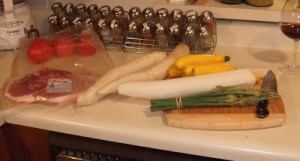
Our Saturday supper started off with promise. We made a trip to the Raleigh Farmer’s market and picked up a bounty of fresh produce and pork raised on a small, local farm:

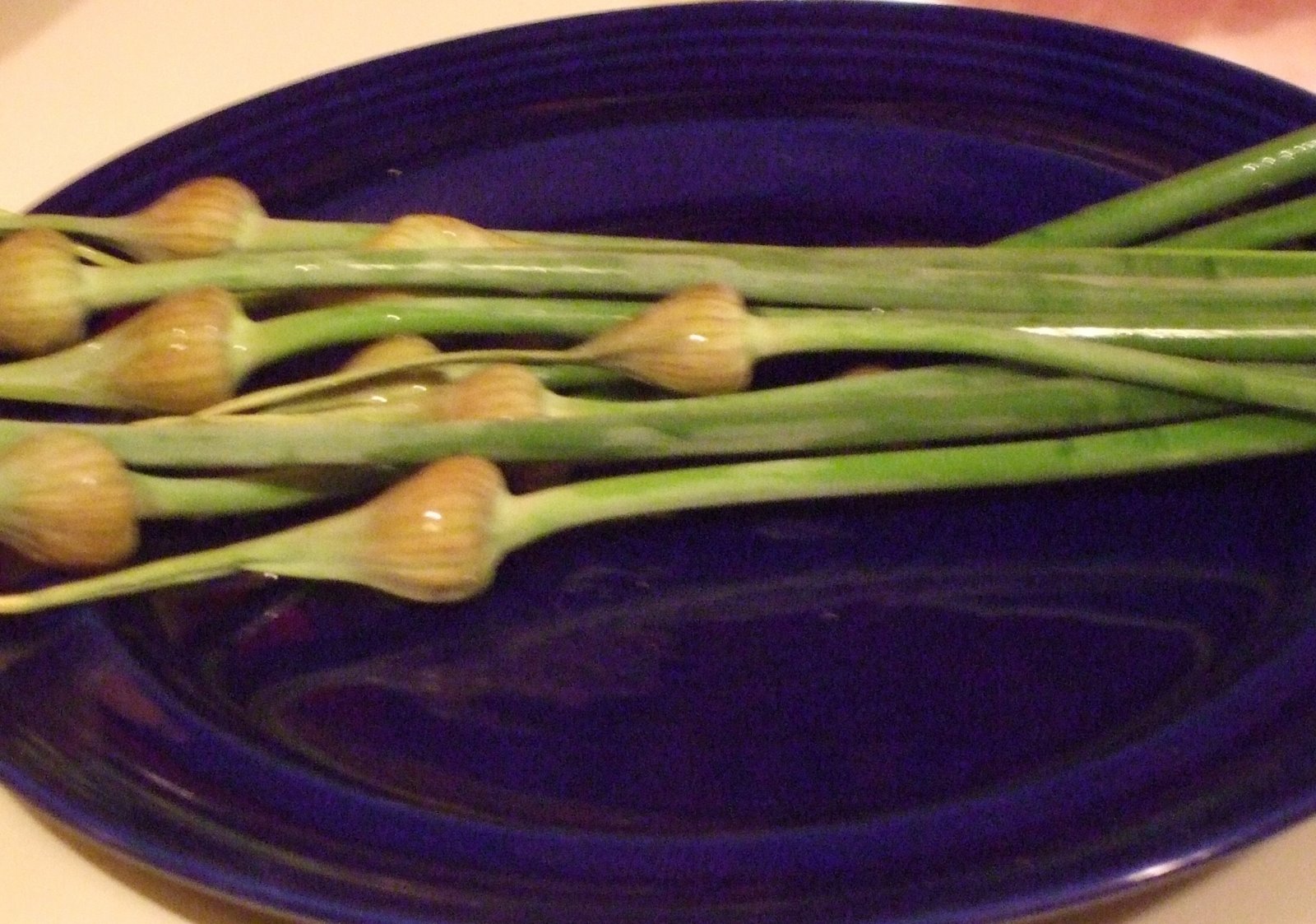
Pork, tomatoes, Daikon radish, zucchini, and elephant garlic sprouts

The garlic sprouts looked beautiful.


As did the spring onions.


“What could possibly go wrong?” you ask. Well, I committed the cardinal sin of cooking fresh vegetables: I got fancy. I sauteed the daikon radish in chicken broth, added some of the garlic sprouts, cream, and a few other things I can’t remember. It was a mess of flavors, the culinary equivalent of puce, the tastes competing with rather than complementing each other. A similar disaster occurred with the zucchini.

It was another reminder of the most important rule to follow when you have fresh, seasonal vegetables: Steam them, add some olive oil or butter and salt, and leave them alone.

But then there was the pork. What a spectacular pig it must have been. It came from Mae Farm Meats in Louisburg, NC, whose web site shows happy, fat pigs lounging in the sun. A happy pig is a tasty pig. The ham steak we purchased was surrounded by a beautiful layer of flavorful fat, and it was arguably the best pork I’ve ever had. I can’t wait to try the bacon–and I cannot resist adding that it was $2 per pound less than Whole Foods.

Pork Belly

The title here does not refer to the current state of our waistlines (apt though the description may be), but to the dish I made last week. Of course, our continued love of food like this is utterly destroying our feeble efforts to lose wei–um, eat more vegetables and try to be healthier.

Pork belly, as you may know, is quite the rage these days. It’s basically uncured, unsalted bacon, and most recipes I’ve seen use a cut large enough to roast. The beauty of the belly is that like bacon, it has lots of lovely fat, which produces a wonderful abundance of porky flavor.

Our belly did not come to us as a roast, but in thick bacon-like slices. We found them at Food World here in Durham, a former Winn Dixie south of downtown that has been transformed into a Latin/Asian market. Actually, “transformed” is too strong a word. The aisle signs remain unchanged and so bear no relation whatsoever to the actual items contained therein. (I found myself staring at 15 different kinds of soy sauce in an aisle labeled “Flour, Sugar, Cake Mixes, Baking Supplies.”) It is also not notable for sparkling cleanliness–it’s not dirty, exactly, just a little rough around the edges. But the prices are spectacularly low, and the store contains a bonanza of foods you won’t find at even on the snooty shelves of Whole Paycheck. A bag of 50 or so dried morita peppers? $3.99. At Southern Season, you’ll find similar items for about a buck–for each pepper.

But back to the belly. The bacon cut is more typically of Asian food (the label was in Korean, I think, which was mercifully translated), but since we had purchased so many wonderful Latin American foods, I decided to make a Latin version.

Chipotle Pork Belly Slices with Potatoes

8 slices pork belly
2 medium onions, finely chopped
Olive oil for sauteing
2 large potatoes, cut in 1/2″ pieces
4 cloves garlic, minced
4 chipotle peppers, crushed and minced
1 tablespoon sea salt, or to taste

Boil potatoes gently in salted water, covered, until just tender, about 10 minutes. Drain. Preheat oven to 350. Saute onions in olive oil until translucent. Mix garlic, peppers, and salt in small bowl. Place four slices of belly in bottom layer of roasting pan. Sprinkle with half of garlic/pepper mix. Add potatoes. Add onions. Cover with remaining pork belly slices. Sprinkle remaining garlic/pepper mix over top. Bake for 30 minutes.

Why Is Durham SO EXPENSIVE?

Fred and I sorely miss many things about Atlanta, but aside from friends and family, what inspires the greatest sadness and deepest sense of loss is the Dekalb Farmers Market. I mentioned it briefly in a post last year on this blog, but then I did not fully appreciate its splendor. We failed to understand that finding whole bean Ethiopian Yrgicheff (how DO you spell that?), Columbian, Sumatran, and Kenyan coffee at under $6 a pound was not something you found every day. We balked at Hawaiian Kona coffee that cost $13 a pound. We took it for granted that we could buy fresh wild caught Alaskan king salmon, Chilean sea bass, halibut, and sashimi grade tuna for under $15 a pound. And cheese. And grass-fed beef, and quail, and free-range chicken, and goat, and many vegetables I’d never seen in my life.

Now I stand, heart palpitating, at the few places where we can find these things here in Durham, wondering how a 30% salary increase could disappear so quickly. Instead of standing next to immigrants from Ethiopia, Mexico, India, and Russia, poring over inexpensive “speciality” items together, I’m now pointy-toe-to-Birkenstocked-toe with Volvo-driving, self-righteous Chapel Hill liberals who are gushing over $22 a pound Hawaiian Kona and free-range local chickens that cost $23 each. I am not joking–TWENTY-THREE DOLLARS FOR A FOUR POUND CHICKEN. I don’t think there’s a font size, or exclamation points, that will adequately convey my shock and horror.

(Side note: I still won’t vote for a Republican.)

Back to School with Husband

I promise to return to cooking school this week, but it was an unexpectedly joyful and momentous weekend in the Wise household. Fred is here to stay! His return happened a bit more quickly than I’d dared to hope, so suffice it to say we’re thrilled to be back together.

Of course, Fred’s arrival necessitated a festive meal involving some form of animal flesh, and I used the opportunity to implement Lesson 1 on mis-en-place. As Fred writes in his blog entry, I purchased his favorites: cheese, steak, and peanuts. We won’t quibble very much over his failure to list the maple pecan pie I made him from scratch, with a wonderful butter crust that actually managed to be flaky, but I am sure that our friends who will receive all the remaining pieces will be appreciative.

The ingredients from the meal came from Trader Joe’s in Chapel Hill, and the visit marked my first excursion to a Trader Joe’s. The store does not have the feel of luxury and glamour I get from other stores that offer $8 per pound bacon, but then again, I didn’t spend my Whole Paycheck there either. (In all fairness, I did see uncured bacon there that was actually more than $8 per pound, but the $6 bottle of actually drinkable cabernet sauvignon made up for it.)

But that’s really the subject of another entry. Trying to implement Lesson 1, I tucked my towel in my apron, as the professional chefs who commented last time recommended. I discovered, however, that my kitchen is just too tiny for this to matter. The reality is that the towel that hangs on the oven door and the one on the wall next to the “pantry” are always within easy reach. (I will download a photo to demonstrate as soon as I figure out how to do that with Fred’s new camera.) Other items, such as spoons and spatulas, are so handily located that all I need to do is make sure they’re clean and in place.

What was helpful, though, was thinking through how I was going to prepare and set out the meal, even though it was quite simple: an appetizer of bought olive bruschetta and crackers, two cheeses, and bought honey roasted peanuts; steak; a salad of baby greens with button mushrooms and Irish cheddar cheese; and the maple pecan pie. Typically, my technique is to dive in and beginning preparing one thing that will take a while, somehow hoping that I’ll have time to do everything else as the first item is going. But this time, I set out the ingredients and thought about the entire meal first. Here’s how it went.

Step 1: Make pie crust and refrigerate.
Step 2: While pie crust is chilling, set out appetizers, except cheese, on nice plates. Include spoon for nuts and knife for cutting cheese. Remove cheese from wrapper, set on board and cover with plastic wrap in refrigerator before serving. (The cheese would have been fine set out, except it would have ended up on the floor with suspiciously cat-shaped teeth marks covering the remains.)
Step 3: Salt and pepper steak and drizzle with Worcestshire sauce. (This is Fred’s favorite marinade.)
Step 4: Rinse mushrooms and set on paper towel to dry. Julia Child says you don’t have to rinse them, but I just can’t help it.
Step 5: Make dressing for salad with olive oil, spicy mustard, and balsamic vinegar.
Step 6: Grate cheese and store in refrigerator.
Step 7: Roll out pie crust, set in dish and flute edges, and refrigerate.
Step 8: Preheat oven for pie.
Step 9: Put pie ingredients into shell and bake pie. Take pie out of oven before you leave to pick up husband at the airport so pie will have time to set.
Step 10: Pick up ailing husband, who is suffering from a cold that has depleted his appetite, an hour later than planned. Arrive home at 10:00. Munch on appetizers and cut into pie that has not had time to set but is still good. Leave steak and salad for the next day and go to bed.