Fred at Durham Art Walk

We’d love it if you would come to see Fred’s work at the Durham Art Walk this weekend, Nov. 1 – 2. We’ll be in the West Village Apartment lobby, across Morgan Street from Tosca.

Our recent trip to New York, where Fred visited the Met, MoMa, and the Frick, has fueled a creative streak that’s filled our apartment with about 50 new watercolors, including the watercolor below is inspired by the Italian artist Giorgio Morandi. (It’s one of my favorites.)

Much as I love Fred’s work, I would be thrilled if it could find a home outside our dining room. To address this problem, we’re buying a house in Trinity Park with an art studio. You can come see paintings and watercolors there too.

Through all this, I keep cooking–the only thing that keeps me sane. This weekend, we returned to an old favorite: pinto beans and cornbread. I firmly believe that only two people raised on “country cooking” in the South can fully appreciate the joy of a dinner consisting of pinto beans and cornbread. I don’t see a point in offering a recipe–you put a pound of beans, a few slices of salt pork or bacon or ham, onions, and salt in a crock pot and cook on high for 4 – 5 hours, or low for longer. But when you’re buying a house, there’s no dish that can make you feel more frugal and virtuous.

No such thing as too many collards

Perhaps it’s come to your attention that our Weight Watchers updates have decreased in frequency. We haven’t quit; we’ve just plateaued. Our collective weight loss stands at 32.8 pounds–15.8 for me, 17 for Fred. With just 1.2 pounds left for me and 6 for Fred (to reach his initial goal of a 10% weight loss), we’re now entering the final push.

This means more soup. At least that’s what was suggested at our last WW meeting.

If you’ve ever wondered how Jell-O salad ever got to be popular, come to a Weight Watchers meeting. I’m often stunned at the culinary tactics some of my fellow members deploy in the kitchen.

In our last meeting, the leader divided us into groups to come up with ideas for fall soup recipes. Our group (led–some might say dictated–by me) devised a spicy butternut squash chowder. This idea was met with murmured confusion, even by some group members. (But like Sarah Palin, and Stalin–who must be related to her since Alaska is so close to Russia–I had managed to suppress dissent.)

The most popular idea was to take a bag of frozen vegetables and dump some canned chicken broth in it. I was forced into seething, bitter retreat.

In response, I offer this very simple but MUCH better dish, which I made the next night.

Brat, Butter Bean, and Collard Soup

3 pork brats or sausages, quartered lengthwise and sliced

NOTE: The brat should have enough fat for the saute. If you use brats made with a low-fat meat like turkey, add oil or chicken stock to the saute mix to keep it from burning.

4 cups collard, cleaned and chopped
2 medium onions, chopped
4-5 cloves garlic
1 can butter beans, undrained
1 tsp sage
1 tsp thyme
2 bay leaves
1 whole dried chipotle pepper
Salt to taste
Water or chicken stock to cover

Heat chopped brats on medium heat. Add onions and saute until translucent. Add garlic and stir. Add remaining ingredients. Cover and cook on medium heat for about 1/2 hour.

Food for Hard Times

ALERT: RECIPE CORRECTED! (See below.)

Greens used to be the vegetable of the poor. My Depression-scarred grandparents adored them and passed that love on to me. In the fall, my grandfather plowed up our vegetable garden and sowed the field in turnips. By early November, we would have not only turnips, which kept for months, but also the turnip greens. My grandmother would preserve them by cleaning, blanching, and freezing them, so they too would be available throughout the winter. We also relied on collards, which are in season right now. (We got some lovely batches in the last few deliveries of our CSA.)

Greens make me think of my grandparents, and I’ve been wanting to talk to them a lot lately: “Are you as worried as in 1929 as I am now? Do you think this is going to be as bad?” This morning I woke up and actually thought I should give them a call, then realized they aren’t available anymore. All I can do now is cook the foods they ate when times were hard–even if they now show up in stores whose prices would have sent my grandparents into apoplectic shock.

I’ve shared one recipe for greens on this blog (Hulga’s Vegetarian Collard Greens), but was shocked in perusing my archives that I haven’t featured more. So here’s one from last week that will give you something to do with your fall vegetables.

Butternut Squash and Collards with Penne (2 large servings)

1/2 pound penne pasta
1 medium butternut squash (can substitute any fall squash, including pumpkin), stem removed, halved lengthwise, and seeds scooped out, plus 1 tsp. olive oil for roasting
3 cups collards with stems, chopped (turnip greens, mustard greens, or kale would probably work too)
1 tbsp. olive oil or 1 cup chicken stock for sauteeing
1 large onion, quartered and sliced thin
4 large cloves garlic, minced
2 tsp. crushed red pepper (add more or less to taste)
2 – 3 cups chicken stock
Salt to taste
Grated Parmesan cheese for serving
NOTE: Save seeds from squash to roast, either for garnish or a snack

1. Preheat oven to 350. Baste halved butternut squash with olive oil. Place cut side down on jelly roll pan or cookie sheet. Roast for 30 minutes or until soft.

2. Meanwhile, saute onion in olive oil or chicken broth in large skillet on medium high heat until translucent. Add garlic and stir. Add collards, crushed red pepper and salt. Turn heat to low and cover. Cook on low heat, stirring every 5 minutes or so, for about 15 minutes. Turn off heat and set aside, covered, until squash is done.

3. Put salted water on to boil and cook pasta according to package directions. Drain.

4. When squash is done, scoop out of skin and add to collard mix. Add 2 cups chicken stock. Stir together. Continue to add stock in small amounts until squash has reached consistency of thick tomato sauce. Mix with pasta in large bowl. Serve with grated parmesan cheese. Garnish with roasted butternut squash seeds if desired.

Roasted Butternut Squash Seeds

Preheat oven to 400. Rinse squash seeds and remove most of flesh. Spread out between two cloth towels and pat dry. Place in small bowl. Add 1 tsp. olive oil, salt to taste, and stir. Spread on jelly roll pan or cookie sheet and roast for 15 minutes or until lightly brown.

So Much Going On . . .

I have been so busy trying to put together a panel today on sustainable agriculture at Duke Divinity School, which employs me, that I did not even think to publicize it in this blog. It was a lively discussion about how better to feed the poor in this country while improving our agricultural practices. The upshot: We need policies to fight poverty, not just food banks to plug up the holes that exist. And we need to develop economies that will make healthy, fresh foods available to all, not just those who can afford to buy local, organic produce.

Panelists were Mark Winne, author of Closing the Food Gap: Resetting the Table in the Land of Plenty, and Divinity faculty members Norman Wirzba and Ellen Davis, both of whom write on ecology, agriculture, and the Bible. (Ellen’s new book, Scripture, Culture, Agriculture: An Agrarian Reading of the Bible, will be out next month.) These are authors worth reading, and a subject worth discussing, especially in the land of Whole Paycheck.

Love at First Sight

The Federal may now have a rival for first place in our culinary hearts. We met our new love at the end of a couple of hours spent looking at houses yesterday. (We continue to labor under the delusion that we can afford to keep our still-unsold house in Atlanta and buy one here too.) Too tired to cook, we stumbled into Rockwood Filling Station (2512 University Drive), Durham’s new “Neapolitan Pizzeria.”
We were seated outside in the warm night under the full moon. I was happy despite being a sartorial wreck, clad in not terribly clean flip flops, jeans, and a tank top, with my wispy, flyaway hair pulled back in a ponytail. The only consolation was that the jeans were my skinny ones, which are comfortable now for the first time in 8 months.
The menu was promising–an array of pizzas much like those you see in Italy, which you would certainly hope for and expect in a place that bills itself as authentically Italian. And then our waiter came to tell us about the specials.
“First off, we have arancini, which are fried risotto balls . . . .”
I couldn’t believe my ears. “Arancini?” I said. “That’s kind of unusual. Isn’t that a Sicilian dish?”
My waiter seemed pleased and no doubt surprised at this remark from the poorly dressed woman with the bad hair. He smiled. “You win the prize! You’re the first person tonight who knew that.”
I went on, ever the good student eager to show the teacher that I knew the answer but pretending I was talking to Fred. “Yes, ‘arancini’ is Italian for ‘oranges.’ They’re called that because the fried risotto gives them a dimpled appearance like the outside of an orange.”
“That’s right,” the waiter said.
I waited expectantly for the “prize.” A free martini would be ideal, but a gold star would do. None being offered, I made do with the arancini themselves.
They were prize enough. I’ve been eager to sample this dish since my friend Rocco, my expert on all things Italian, told me about them on a trip to Rome a few years back. But I never saw them on the menu then or in a subsequent trip back to Italy, and never in the U.S.
This being my first time with arancini, I can’t say how they would compare to what you’d get in Palermo. But these were wonderful–crispy and tender all at once, like a perfect hush puppy, if hush puppies were lumpy and made with cheese. These had mozzarella and a few other things that neither Fred nor I can remember; we ate them too fast. They were served with a spicy marinara sauce, which nicely offset their creaminess.
My entree was the pizza special–arugula, truffle oil and Parmesan, done perfectly. There was so much arugula it kept falling off and just enough truffle oil to offer its indescribably rich and heady undertone without overwhelming everything else. We also threw caution and weight watching to the winds and ordered fried calamari, which included some whole ones with their tender little tentacles as well as the typical rings. The breading was delicate and crisp, flavorful without being spicy. Poor Fred, who ordered it despite my harrumphing about how fattening it would be, ended up getting very little.
We were also pleased by the mid-range prices. Our meal, including one glass of wine and one beer, was $44 with tip. Of course, if we do end up buying one of these houses, we’ll never be able to eat out again.
P.S. I’m a bit late on the Rockwood review bandwagon. Carpe Durham and Delicious Durham have already posted entries that have generated a lot of comments. But whatever kinks were there in the first few weeks, I think they’ve started to work themselves out.

Education

My confidence as a cook was somewhat restored last night when I used my Ranney Ranch soup bones in what I can only call Un-Split Pea Soup. (I don’t offer a recipe, though, because while the beef was good, the recipe itself still needs work.) These tasty little morsels consist of a bone (obviously) surrounded by about three inches of meat. This time I kept it simple–searing the soup bones in a little olive oil, sauteeing with onion, adding garlic and then soup ingredients. The smell of the meat cooking in the pot was heady, with a slight undertone of something else–cloves, perhaps, or New Mexico grasses, or maybe just a memory of home.

I also discovered that the ranch offers a recipe for arm steak on their web site. It does not call for smothering the meat in bad barbecue sauce.

As for the Un-Split Peas: These were acquired on our trip to Food World (home of the mysterious and delicious little peppers I have yet to identify). I was excited to try them. They were labeled “whole dried peas,” and they consisted of small, yellowish-green pods that I imagined would puff up slightly, like black-eyed peas, and might make an interesting addition to a salad.

It’s probably pointless to go on. You know how the story went–the slowly dawning realization during cooking that the pods looked an awful lot like peas, only dried; the wonder at how quickly they were softening; and the final burst of insight upon tasting them: “Whole dried peas. Oh yes. Split peas, only . . . not split.”

Culinary Disasters

Our rut continues, but even in the midst of our doldrums, we have lost a collective 27 pounds–14 for Fred, 13 for me. The reason may lie in some spectacular culinary failures in the last couple of weeks, which go a long way toward keeping portion sizes under control.

The worst resulted in the sad destruction of a pound or so of arm steak from Ranney Ranch, owned by a colleague from Duke. Ranney Ranch raises “grass-finished” beef, and having grown up on a beef cattle farm, I was looking forward to trying it. But from there, things went downhill.

As far as cooking arm steak is concerned, I had the same amount of experience as someone who’d never accidentally stepped in a “manure pile” by accident. (It happens, you could say.) I suspect that this cut ended up as “ground beef” (which my grandfather adored) when we sent out our own calves to the slaughterhouse. So I was left to scour the internet for cooking ideas, just like anyone else.

My research led me to conclude that a long marinade or braising was the cooking method of choice, since arm steak tends to be tough. As usual, I had no patience with the idea of marinading overnight, so braising it was. Knowing that Ranney Ranch is in New Mexico, I also thought that Mexican spices would be appropriate.

If I’d left it at that, things might have been okay. But after adding chipotle, and salt and pepper, and vinegar (to reduce the gamey taste of the meat, I theorized), and then deciding to throw in tomato, and chili powder, and cumin, and coriander, and brown sugar, and God only knows what else, and then searing it on both sides, and then cooking not quite long enough because it was approaching 9:30 p.m., we were left with some tough meat floating in a sea of what amounted to mediocre barbecue sauce.

I have since learned that grass-finished beef is best cooked simply so that the flavor will stand out. Unfortunately I’m out of arm steak.

In a Rut

Many thanks to those of you who have offered restaurant suggestions to include in our next Barbecue Taste Off. We are looking forward to trying them.

The Taste Off has been the bright spot in the bleak landscape of our culinary life. Cooking has degenerated to a sad post-work effort to get food on the table before we fall into bed at 10. Our meals consist of various combinations of onions, garlic, and random vegetables sauteed in olive oil and chicken stock served over pasta. We are, however, in the middle of an interesting experiment to determine the effects of eating a chicken roasted after thawing on a countertop for twelve hours on a warmish day. So far, we’ve had nothing to match the raw seafood consumed in London on our honeymoon, which demonstrated the depths of our commitment to each other “in sickness and in health.”

I blame fall. We continue to receive tomatoes, eggplant, and cucumbers from our CSA, but the thrill has worn off as the flavors pale with the waning of the sun. We’re in that liminal space between the heady delights of peaches and the rich flavors of butternut squash. We’re in that sad, brief time when we realize how achingly beautiful and painfully short life really is.

Even the cicadas are nearly gone.

The Great Barbecue Taste Off, Part I

Since no one cares about our intense work load, our cat’s toes, or our 1,000 mile sojourn last weekend, I will now deliver the initial results of our Great Barbecue Taste-Off. It’s good to know that at least a few people are interested.

We focused on barbecue in and around Durham, most of which is the traditional eastern North Carolina variety: slow-cooked pork with a lightly spiced vinegar sauce. Debate rages over exactly how to prepare it, and especially over the question of whether the pig must be cooked over wood. Our friend Paul, who gamely joined our efforts, is so insistent on this point that he spurns barbecue joints that don’t feature smoke pouring from somewhere on the roof.

But this is the kind of dilettantish fervor that we wanted to put to the test. (Sorry, Paul.) We didn’t want to be fooled by the charm of a run-down shack on the side of the road that no one had discovered, or swayed by Gourmet’s rave reviews of the painstaking efforts of an elderly country man who raised the pigs on turnips from his garden and chopped the wood for the fire himself. We wanted to base our opinion solely on a double-blind experiment that compared each barbecue side by side and where the only deciding factor would be the taste of the meat.

Considering that all three of us are humanities majors, we were quite proud of the experiment we devised. Even Paul, who confidently proclaimed that he would easily recognize every contestant, was unable to tell which was which. (The exception was the Q Shack’s pork, which we probably should not have included since it’s too heavily sauced and uses too much tomato to be classified as eastern North Carolina barbecue.)

Below are the results.

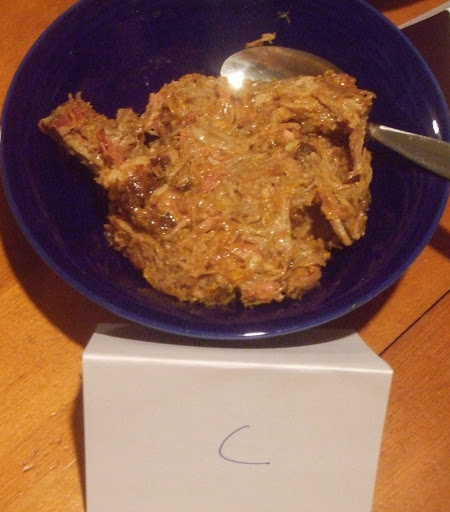
#1: Bullock’s (3330 Quebec Dr., Durham; 919-383-3211). With an interior that resembles HoJo’s circa 1985, big crowds of diners who probably wish HoJo’s would make a comeback, a gas pit, and rave reviews from people of clearly questionable taste, I didn’t expect much from this contestant. And there was also our own visit in May, which resulted in my firm declaration on this blog that “Bullock’s is just not my favorite North Carolina barbecue joint.” But Fred and I put this entry at the top of our list because of the moist flesh and the vinegary sauce with just the slightest overtone of sweetness. (Reviewers on Citysearch complain about the amount of vinegar Bullock’s uses, but it was a plus for us.) Not surprisingly, Paul wanted more smokiness, but this entry still came in a close second for him. And all of us loved the bits of fat in the meat. Some NC barbecue afficionados sniff at pit masters who don’t pick out the fat when the meat is chopped or pulled. But I cannot understand why a people raised largely on pork fat tossed into every vegetable dish would ever complain about such a thing.
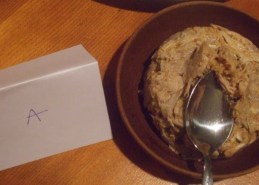
# 2: Backyard Barbecue Pit (5122 NC Highway 55, Durham; 919-544-9911). The Backyard Barbecue Pit has everything you want in a real barbecue joint: smoke, wood, pigs roasting outdoors on a site that indeed resembles your country neighbor’s backyard, and a great review by H. Kent Craig, a true barbecue fanatic. (Craig’s review also offers a wonderful descripion of the restaurant and the cook’s process.) Had I been asked to predict a winner, this would have been it. But philistine that I am, I put this at #4. Paul and Fred catapulted the BBP into #2 by placing it at #1 and #2 respectively. All of us agreed that the meat was moist with hints of sweet, and Fred was particularly impressed by the fine chop. But I missed the fat that the pit master so carefully pulls out (see Craig’s review).
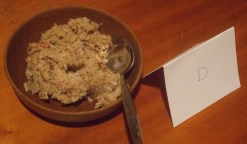
And here is where the experiment began to show just how ridiculous our whole enterprise is to begin with. I found the meat “not smoky.” Paul liked the “smoky” taste, while Fred called it “spicy” and “exciting.” Though I’d placed the BBP at #4, I had to confess that on another day the entries I’d ranked #2 – #4 might have been in a different order. The good news is that there really was no bad barbecue among our contestants. The bad news is that we are not as clever as we think we are.

#3: The Original Q Shack (2510 University Dr., Durham; 919-402-4227): Only a very petty person would criticize the decision of a friend who drove all day picking up barbecue for her taste test, which she would not even let him write about on his own blog. The Q Shack serves Texas-style barbecue, smoked over mesquite and hickory with a tomato-based sauce. As noted above, it was easy to spot in the lineup, but we tried to maintain our objectivity.

Still, ranking The Q Shack was another exercise in quibbling futility. I put it at #2, Paul at #3, and Fred at dead last. We all agreed that the meat was tender. Paul described it as the most “unusual” of our entries, while Fred felt its tomato-y sweetness should have disqualified it altogether. My own hillbilly prejudices came out in my evaluation, which noted that it came in second because there was “not as much fat as A [Bullock’s].”

(Our confusion in ranking this place is matched by my confusion over which Q Shack is which, and I will eagerly accept comments explaining its history.)

#4 (tie) Dillard’s (3921 Fayetteville St., Durham; 919-544-1587). The “Official Bar-B-Que of the Durham Bulls,” as their web site proclaims, this restaurant actually serves a South Carolina mustard-based vinegar sauce. I’ve never been there and have never sampled their fare at the Bulls ballpark, so I had no opinion going in. Including this place was undoubtedly a questionable choice given the different style of preparation, but again, since Paul was kind enough to spend an entire Saturday driving all over Durham buying barbecue, it would be petty of me to complain.

I put this entry at #3, while Paul and Fred ranked it #5 and #4 respectively. I suspected it was South Carolina cue because of its yellowish tinge and found it “smoky, spicy, moist” and less vinegary than I like. Paul described it as “mild,” but Fred’s assessment best summed up our reaction: “somewhat spicy” but “dull.” It was decent barbecue, but set against other entries it didn’t stand out.

#4 (tie) Hog Heaven (2419 Guess Rd., Durham; 919-286-7447). Paul, Fred, and I visited this restaurant over a summer workday lunch and were pleasantly surprised. Like Bullock’s, Hog Heaven doesn’t use smoke. The interior, resembling an underdecorated Chick-fil-A, invites you to sit down, eat your meal, and get out ASAP, although the service was friendly, fast, and helpul. I wasn’t sure how they’d fare in the contest, but I would have given them at least 50-50 odds on winning.

In our test, though, Hog Heaven came in at #3 (Fred), #4 (Paul), and #5 (me). Its biggest flaw was dryness, and like Dillard’s, its flavor didn’t stand out. Paul’s only description was “slightly better than B [Dillard’s],” while Fred and I agreed it was not as spicy or flavorful as some of the others. Inexplicably, Fred felt it had a vinegary aftertaste, while I complained about its lack of vinegar. By now, though, you should have expected that.

Notably absent in this lineup are J.C.’s Kitchen, which I declared was my favorite Durham barbecue last year, and the legendary Allen and Sons in Chapel Hill. We do plan to expand our efforts in a future post, but we’ve learned our lesson and won’t deceive our readers with false promises again.
Apologies

We regret that trivial activities such as our jobs have prevented us from engaging in the important work of writing up our barbecue revue. We really, really will post it this week.

Fred, meanwhile, has obviously gotten light-headed from his weight loss. I arrived home last week to be met with this astonishing news.

Fred: “I got us some new Clorox wipes at the store today. I noticed there were some stains on the kitchen floor, so I wiped them up.”

I stared. I looked at the floor, where two coffee stains, not Swifferable, had been lingering. I looked back at Fred.

“You did what?” I croaked.

“I wiped up the stains.”

“Let me get this straight. You actually noticed there were stains, and you wiped them up?”

Fred began to look worried. “Well, yes,” he said.

He should be worried, I thought. He’s gone mad. How long can this go on?

Later, I noticed a large quantity of paint on the $50 wooden display we’d bought to hold prints for his upcoming art show. Apparently Fred had decided it would make a great easel. “What about the extra easel you have sitting over there?” I asked. “Isn’t that what it’s FOR?”

“Well, it’s all beat up and has paint on it.”

My faith in humanity was restored.